Vintage Guitar Essentials
IDENTIFICATION GUIDE
Menu

Fender
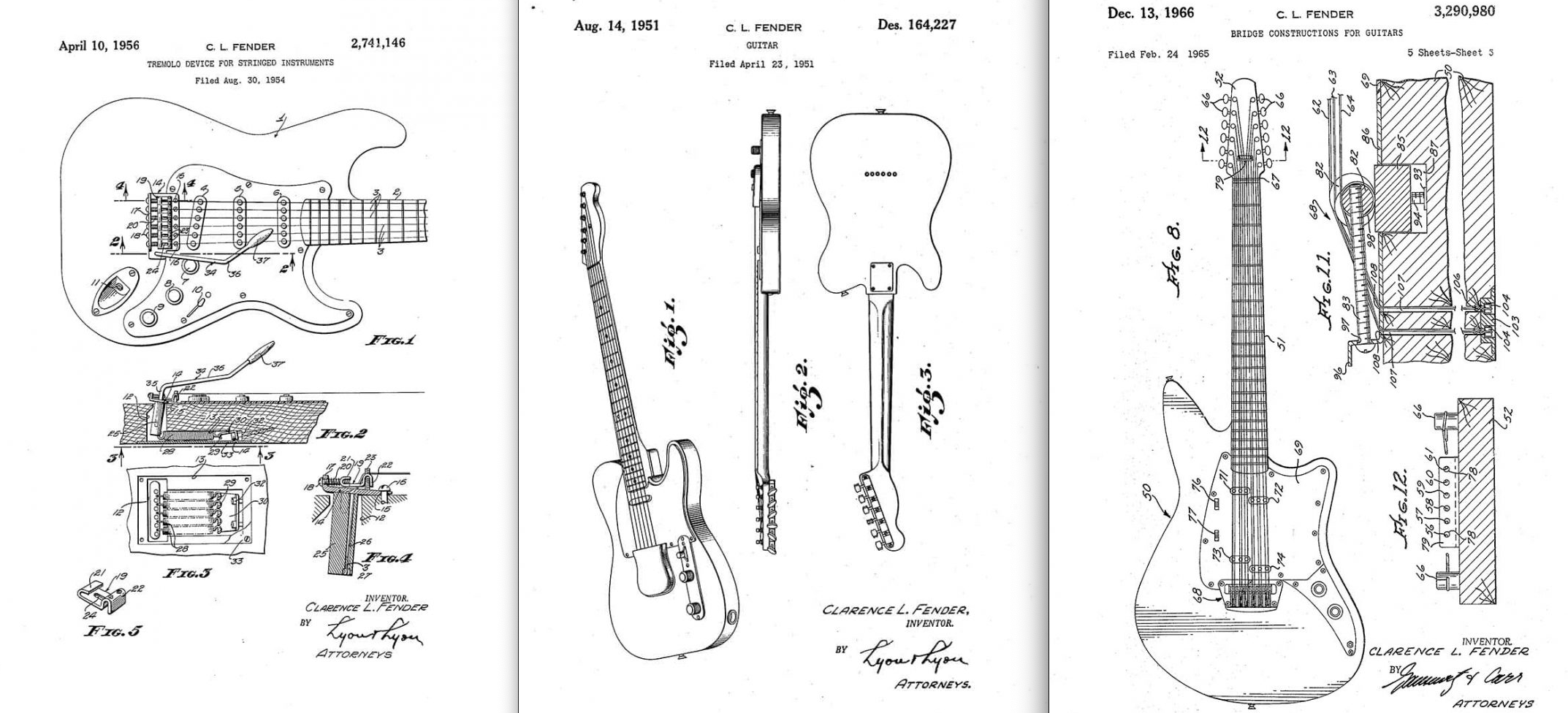
The Fender Telecaster
Inspired by the Paul Bigsby Merle Travis Guitar, Leo Fender built his first electric Spanish in the late 1940s. Leo built steel guitars and Amplifiers out of a small shop in Fullerton California, and the first Esquire prototype was the beginning of what came to be one of the most popular production electric guitars in music history, the Stratocaster.
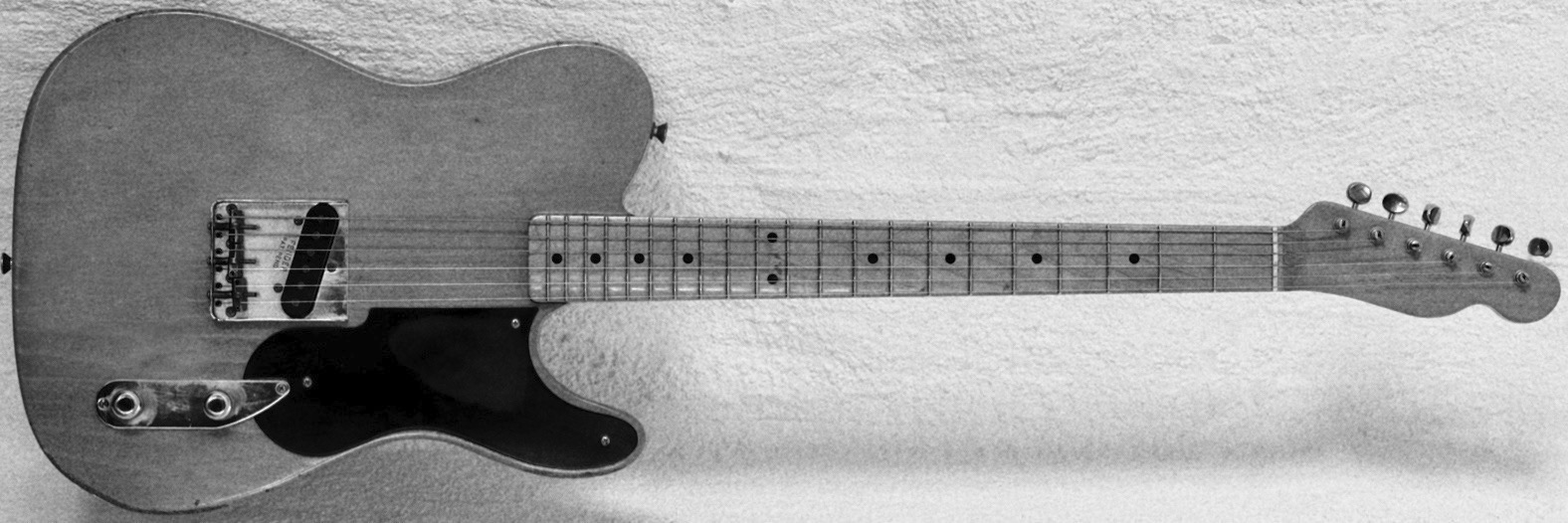
Esquire Prototype 1949
- First prototype "The Snakehead": Pine body, steel guitar like peghead, white, one pickup, no trussrod.
- Second prototype: Six-on-a-side tuners Fender tele headstock. Stripped finnish, non trussrod, one pickup, precision bass like control plate.
- Other prototypes: First Esquire one pickup butterscotch, two pickup, one red, one black known to exist. Pine body, no trussrod.
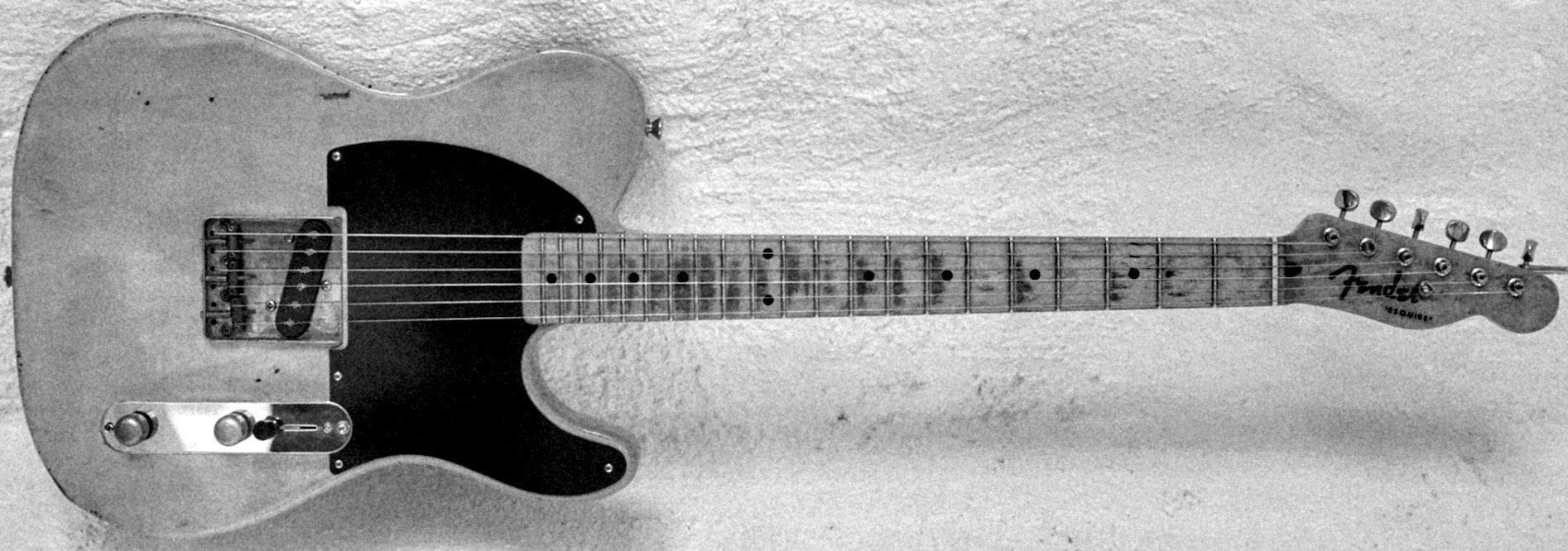
Esquire 1950
- Esquire one pickup Butterscotch. Esquire two pickup Butterscotch.
- Ash body
- Spagetti logo low.
- Serial #. ~ 0000 - 0250
- Shipping Tot. ~ Small numbers
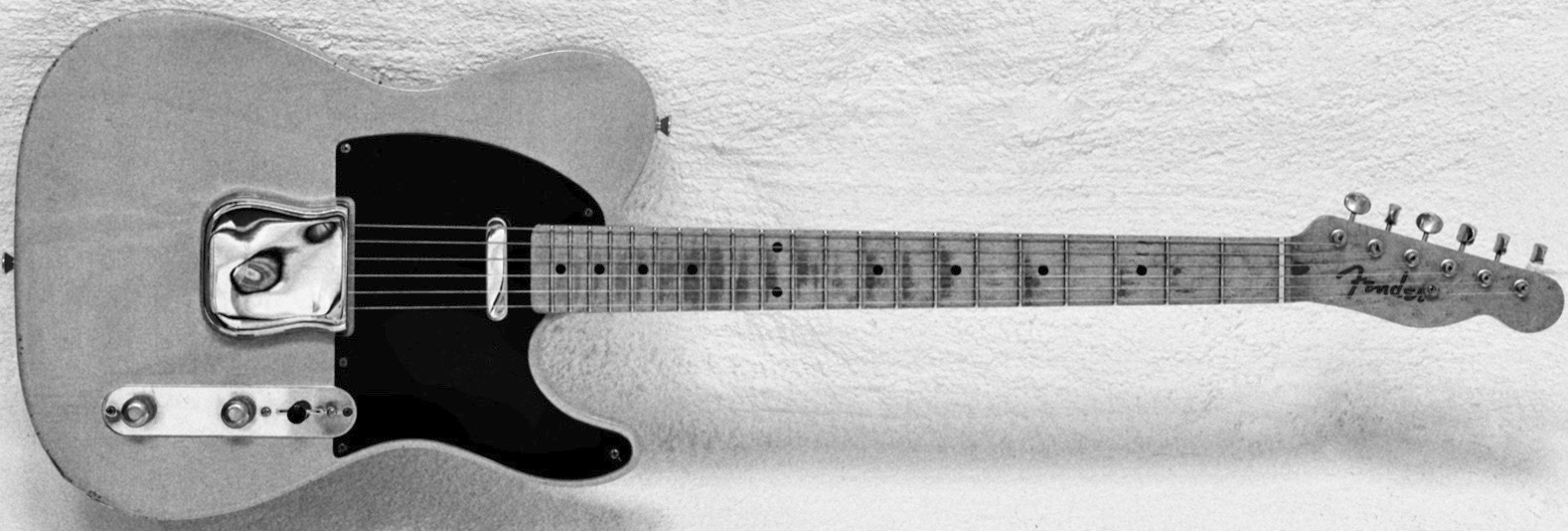
Broadcaster 1950. Nocaster 1951. Telecaster 1951. Black Guard
- Broadcaster, Nocaster then Telecaster and one pickup Esquire.
- Maple neck, black dots.
- Neck incorp. trussrod
- Serial # on Bridge Plate:
~ 33 - 860 = 1950 to 1952
~ 0001 - 0999 = 1950 to 1952
~ 1000 - 5368 = 1952 to 1954 - Shipping Tot.:
~250 Broadcasters
~868 Nocasters, ~250 Esquires in 1951
~700 Telecasters, ~250 Esquires in 1952
~6.000 BG's 1950-1954
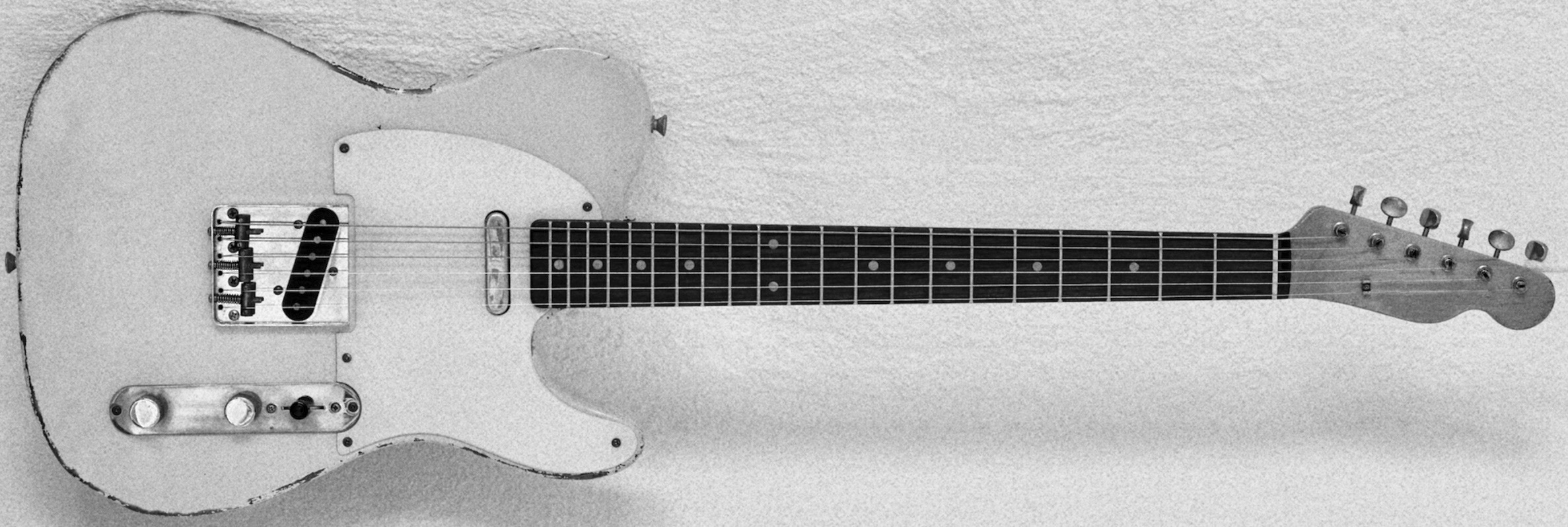
Telecaster White Guard 1954-55 =>
- In 1954 the demand for changes from musicians and salespeople led to the design of the Stratocaster. The Telecaster continued production and change to a blond hue, white guard in -55.
- Sunburst avail. -57
- Squared off knobs -57
- Spagetti logo high -57
- Slab rosewood board, clay dots -59
- Custom Esquire w binding -59
- Serial # on Neck Plate:
~ 0001 - 8000 = 1954
~ 6000 - 10000 = 1955 (some 0 prefix)
~ 01000 - 08000 = 54-63
~ 09000 - 16000 = 1956
~ 16000 - 25000 = 1957 (some 0 or - prefix)
~ 25000 - 33000 = 1958 (some 0 or - prefix)
~ 30000 - 40000 = 1959 (some stamp on low edge)
~ 40000 - 58000 = 1960 (some stamp on low edge)
~ 55000 - 72000 = 1961
~ 71000 - 93000 = 1962
~ 93000 - 99999 = 1963
~ L00001 - L20000 = 1963
~ L20000 - L59000 = 1964
~ L60000 - L99999 = 1965 - Shipping Tot. A lot!
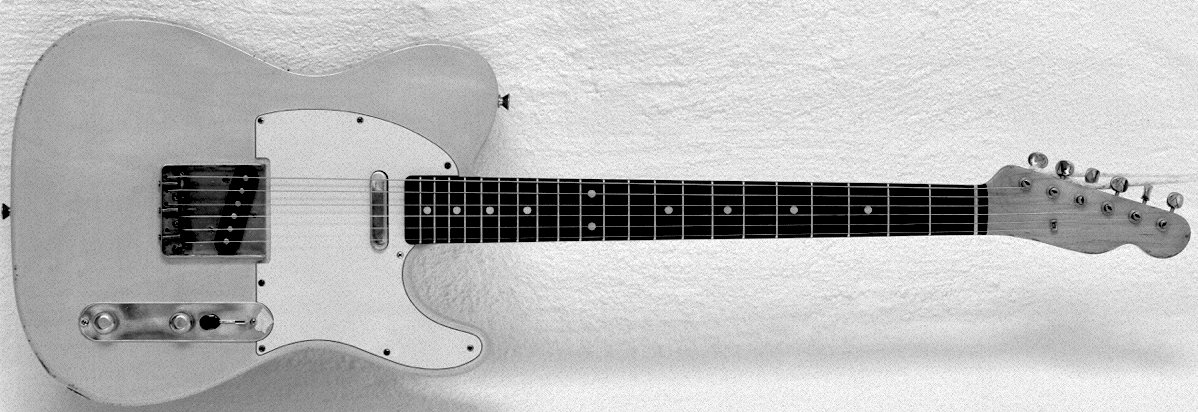
Telecaster CBS and beyond
- Transitional logo -64
- Pearl dots -65
- Black Fender peghead decal -67
- Telecaster Thinline -67
- Serial # F-series:
~ 100000 - 110000 = late 1965
~ 110000 - 200000 = 1966
~ 180000 - 210000 = 1967
~ 210000 - 250000 = 1968
~ 250000 - 280000 = 1969
~ 280000 - 300000 = 1970
~ 300000 - 330000 = 1971
~ 330000 - 370000 = 1972
~ 370000 - 530000 = 1973
~ 500000 - 580000 = 1974
~ 590000 - 690000 = 1975
~ 690000 - 750000 = 1976
~ 670000 - 700000 = 71-76
~ 400000s 73-76
~ 500000s 73-76
~ 600000s 74-76
~ 700000s late -76 - Shipping Tot. Masses!
The Fender Stratocaster
The Fender Stratocaster, born in 1954, is a sleek solid-body electric guitar known for its cool design, vibrato system, and separate bridge sections for each string. Through trial and error, Fender developed unique features like its curved body and Bigsby-style headstock. The Stratocaster addressed the Telecaster’s issues by making the body more comfortable and concealing the jack. However, it took time to perfect its synchronized tremolo system, which became a defining feature.
Spring 1954
- Ash body
- Two-color sunburst
- Spaghetti logo
- No patent numbers
- Round string tree
- No-line Kluson 2356766 PAT. APPLD tuners
- Truss rod adjusts @ butt
- 4 bolt metal neckplate
- April to May serial # on tremolo plate
- => serial # on neck plate
- One piece maple neck
- Black dot markers
- Walnut skunk stripe
- 8 screw single layer white vinyl PG
- Small aluminum sheilding covers control cavity
- White "bakelite" plastic knobs and pickup covers
- 2 piece steel tremolo
- Straight trem arm
- Nickel plated Fender Pat Pend. saddles
- Hardtail model available
- Serial # on tremolo plate. ~ 0100 - 0200
- Serial # on neck plate -54. ~ 0001 - 8000
- Serial # on neck plate -54-63. ~ 01000 - 08000
- Serial # on neck plate -55. ~ 6000 - 10000 (some 0 prefix)
- Shipping Tot. -54. ~ 250
- Shipping Tot. -55. ~ 357 Trem. ~ 95 Non Trem
Fall 1956
- Alder body replaces ash
- Rectangle string tree replaces round string tree
- Single-line Kluson 2356766 PAT. APPLD tuners
- Serial #. ~ 09000 - 16000
- Shipping Tot. ~ 1500
Spring 1957
- Vinyl plastic knobs and pickup covers replaces "bakelite"
- Serial #. ~ 16000 - 25000 (some 0 or - prefix)
- Shipping Tot. ~ 1500
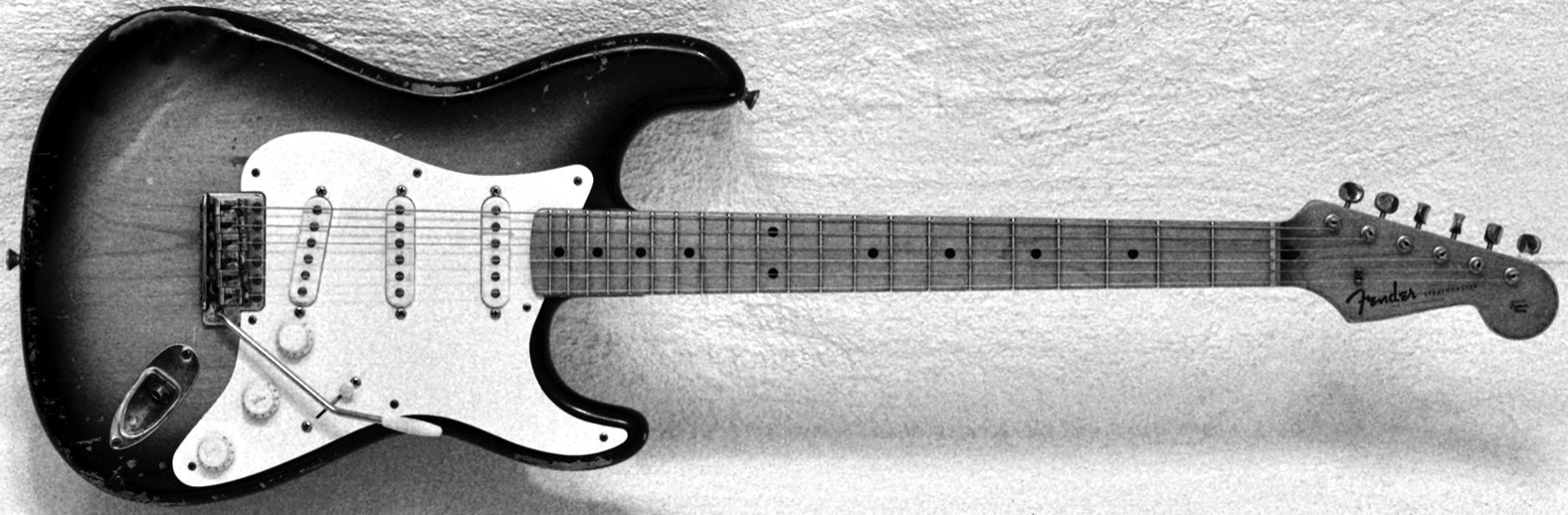
1958
- Sunburst finish changed to three colors
- Single-line Kluson D-169400 PATENT NO tuners
- Serial #. ~ 25000 - 33000 (some 0 or - prefix)
- Shipping Tot. ~ 1500
Mid 1959
- Slab rosewood board with clay dots
- Flat bottom board glued to maple neck
- Mint green three layer celluloid PG, 11 screws
- Some transitional models have 9/10 screws
- Thin aluminum shield size of PG underneath
- Serial # -59. ~ 30000 - 40000 (some stamp on low edge)
- Serial # -60. ~ 40000 - 58000 (some stamp on low edge)
- Shipping Tot. -59. ~ 1500
- Shipping Tot. -60. ~ 1500
1961
- Logo with 2 patent numbers:
- 2,573,254
- 2,741,146
- Serial #. ~ 55000 - 72000
- Shipping Tot. ~ 1500
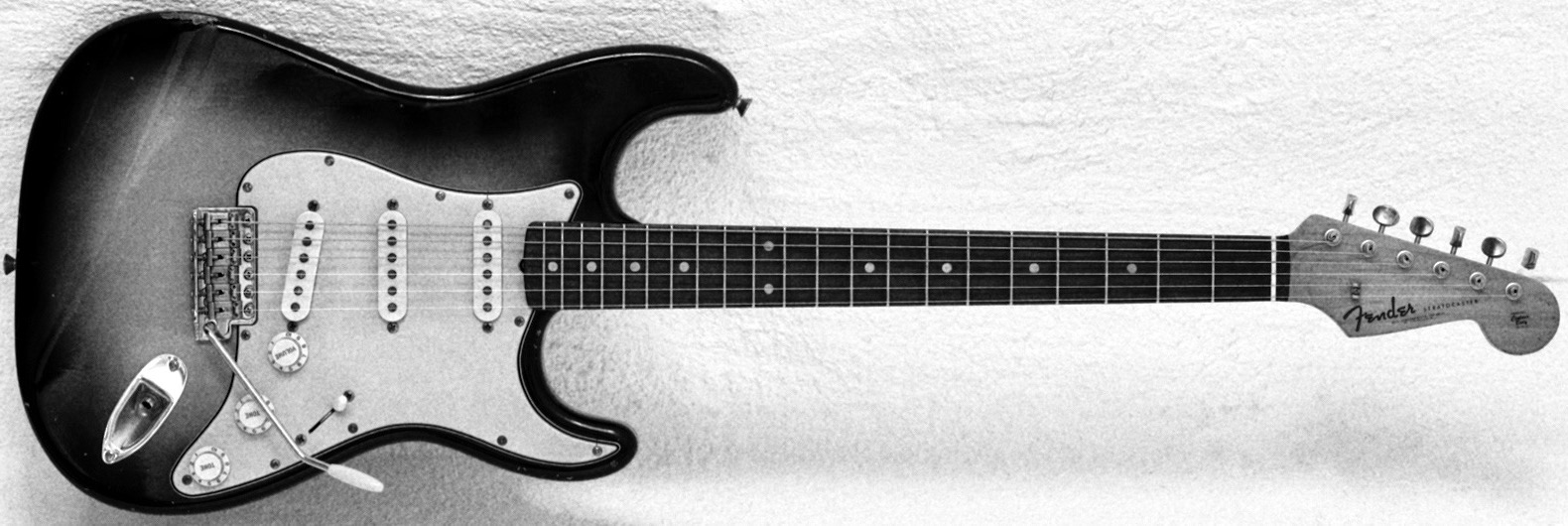
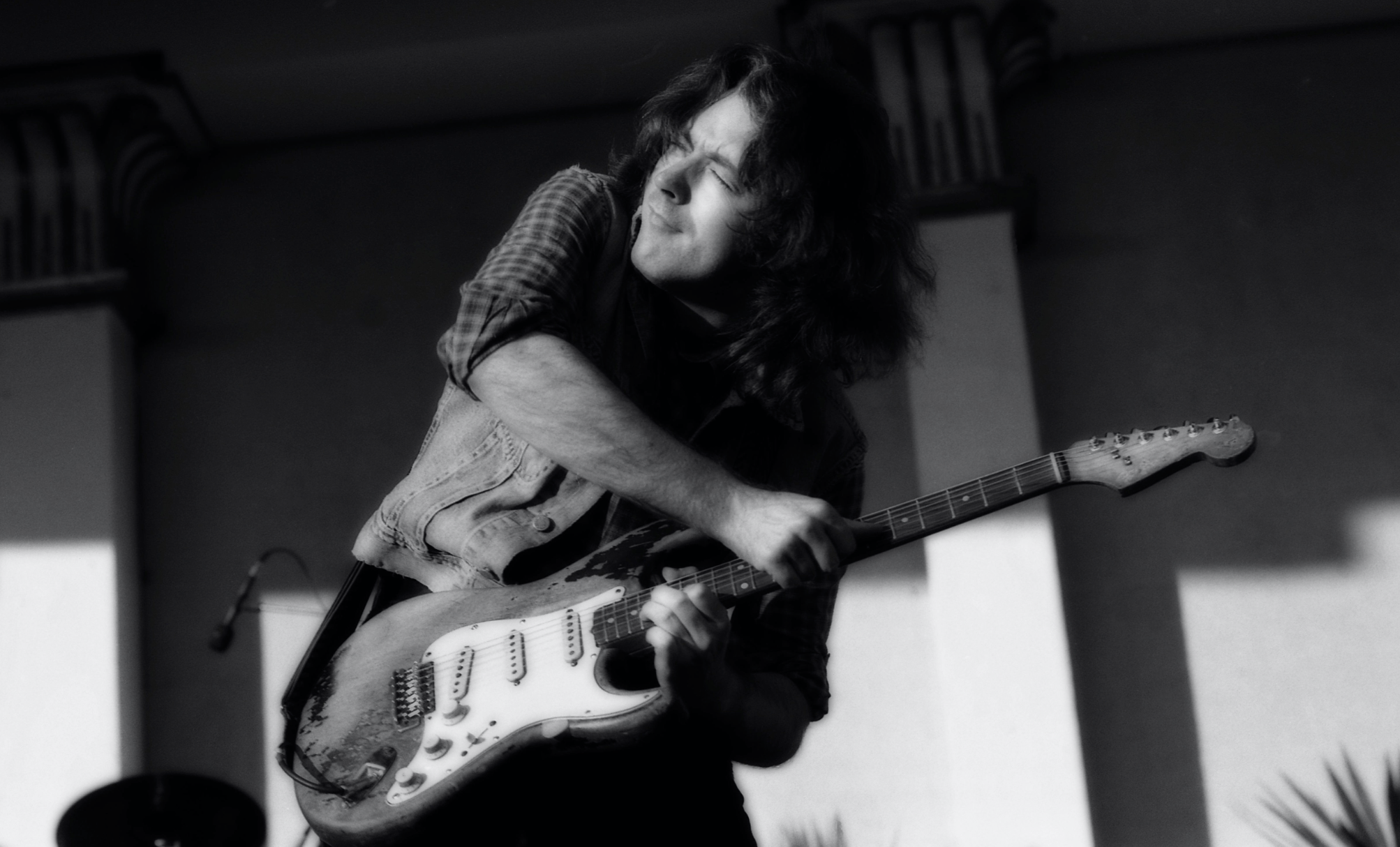
Rory Gallagher's early 60's stratocaster.
1962
- Logo with 3 patent numbers:
- 2,573,254
- 2,741,146
- 2,960,900
- Serial #. ~ 71000 - 93000
Mid 1962
- Veneer rosewood board
- Arched bottom board glued to maple neck
- -63, last year for black bottom pickups
- Serial # -63. ~ 93000 - 99999
- Serial # -63. ~ L00001 - L20000
- Shipping Tot. ~ 3000
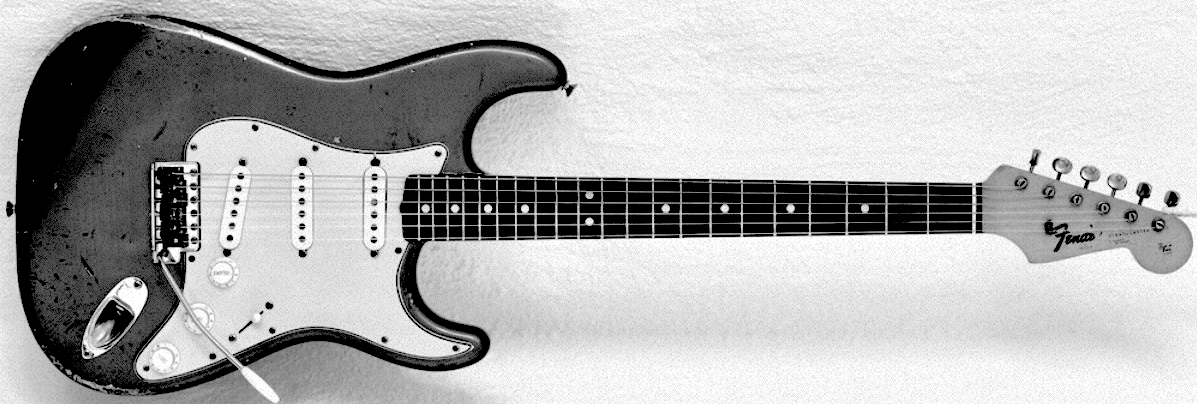
Fall 1964
- Thicker gold "transitional" logo
- Logo with 4 patent numbers:
- 2,573,254
- 2,741,146
- 2,960,900
- 3,143,028
- Doubble-line Kluson D-169400 PATENT NO tuners
- Pearl board dots replaces clay dots
- Transitions with smaller side dots becoming pearl after the top dots
- Plastic white three layer PG replaces celluloid
- Serial #. ~ L20000 - L59000
- Shipping Tot. ~ 3000
Late 1965
- Large peghead
- Maple board optional (2 piece neck, no skunk stripe)
- Logo with 5 patent numbers:
- 2,573,254
- 2,741,146
- 2,960,900
- 3,143,028
- 2,817,261
- Serial # -65. ~ L60000 - L99999
- Serial # late -65. ~ F100000 - F110000
- Shipping Tot. ~ 3000
1966
- Peghead with 3 patent numbers:
- 2,741,146
- 3,143,028
- DES 169,062
- Bent trem arm CBS period
- Serial # -66. ~ F110000 - F200000
- Serial # -67. ~ F180000 - F210000
- Shipping Tot./year. ~ 5000+
1968
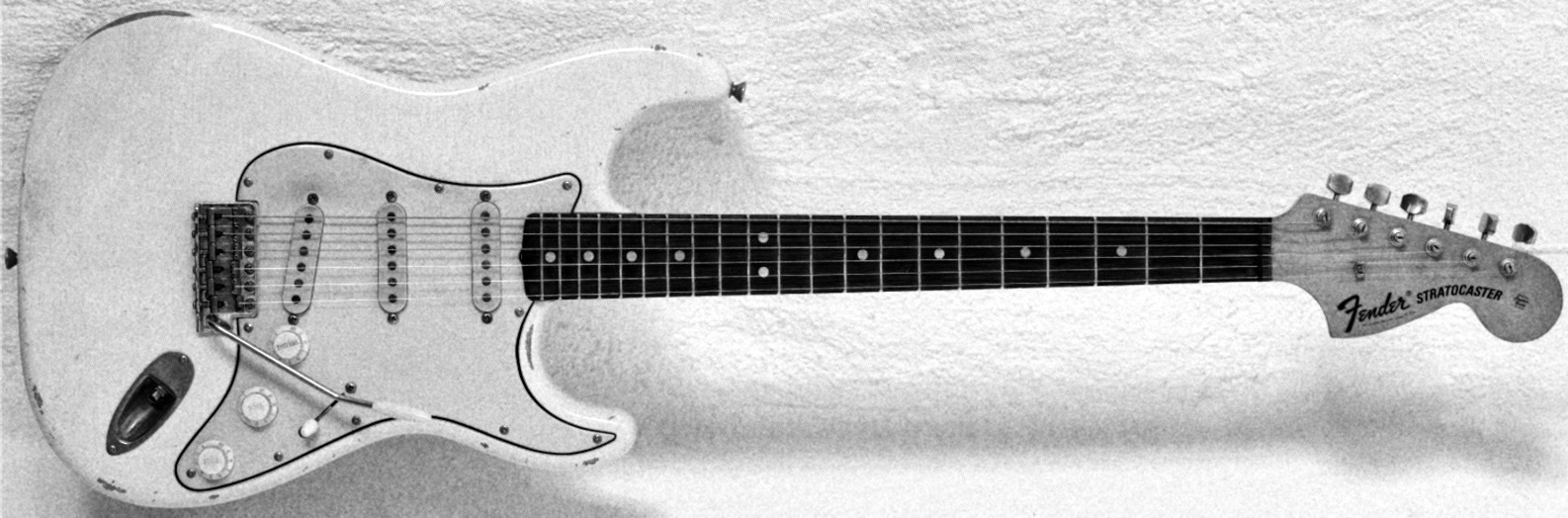
- Black Fender peghead decal with 2 patent numbers:
- 2,741,146
- 3,143,028
- Bold "With Synchronized Tremolo"
- Patented "Orginal Contour Body" by 1969
- F-style tuning gears replaces Klusons
- Polyester thick finish replaces nitrocellulose lacquer
- Squared corner pickup routes 1969-1976
- Serial # -68. ~ F210000 - F250000
- Serial # -69. ~ F250000 - F280000
- Shipping Tot./year. ~ 5000+
1970
- Peghead decal has 1 patent number 2,741,146
- Serial #. ~ F280000 - F300000
- Shipping Tot./year. ~ 5000+
Late 1971
- 3 bolt neck with micro-tilt replaces 4 bolt system
- Die-cast 1 piece chrome Mazac tremolo replaces 2 piece steel unit
- Bridge saddles, cast with no stampings
- 2:nd string tree added, hold G and D strings
- Bullet truss rod adjusts @ peghead
- Serial #. ~ F300000 - F330000
- Shipping Tot./year. ~ 5000++
1972-1974
- Peghead decal patent number changed in 1972 from 2,741,146 to 3,143,028
- Strap button placement pointing forward 1973-1976
- Flush pole pickups replace staggered pole pickups in mid 1974
1975
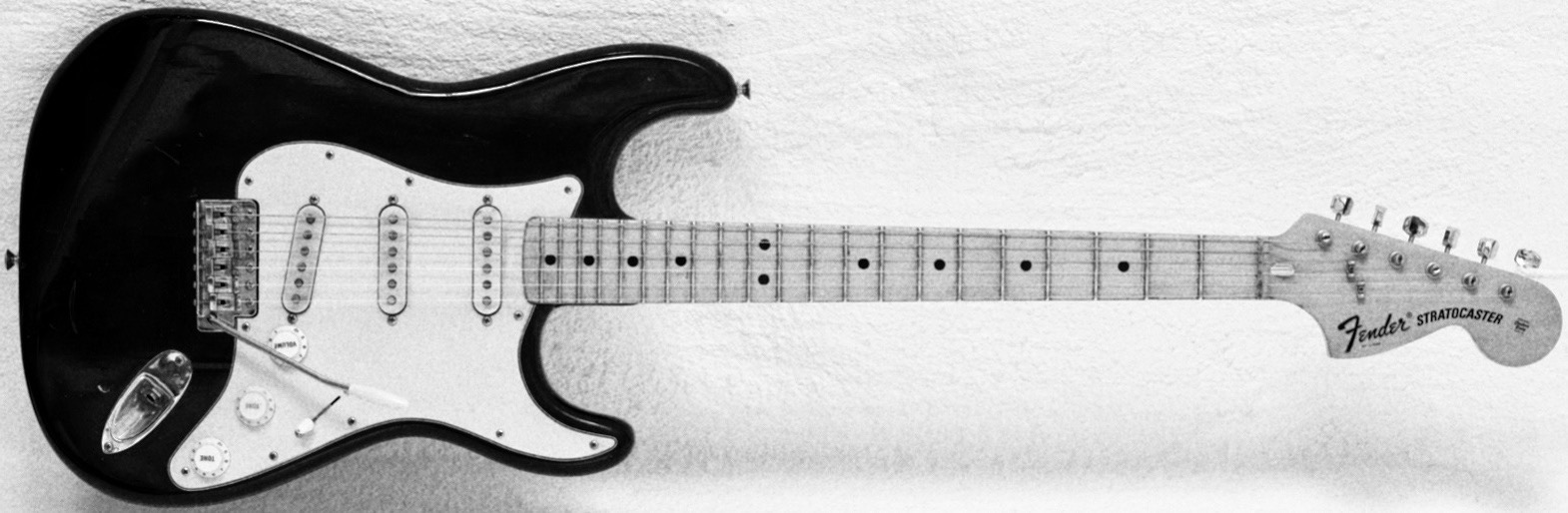
- Black 3 layer PG, black knobs and black pickup covers
- Transitions black pickguards with white knobs and covers are seen first, followed by black pickguards, knobs and covers
- 2:nd gen. Schaller made F-tuners
1976
- Serial number moves to peghead decal
- Worm rout disappear
- 5-way pickup selector in -77
1982
- Last year for the large peghead
Other Fender models
1956: Musicmaster
1956: Duo-sonic
1958: Jazzmaster
1962: Jaguar
1964: Mustang
Bass
1951: Precision Bass
1960: Jazz Bass
1961: Bass VI
1965: Bass V
1966: Mustang Bass
1968: Telecaster Bass (P Bass renamed)
Gibson
The Gibson Les Paul
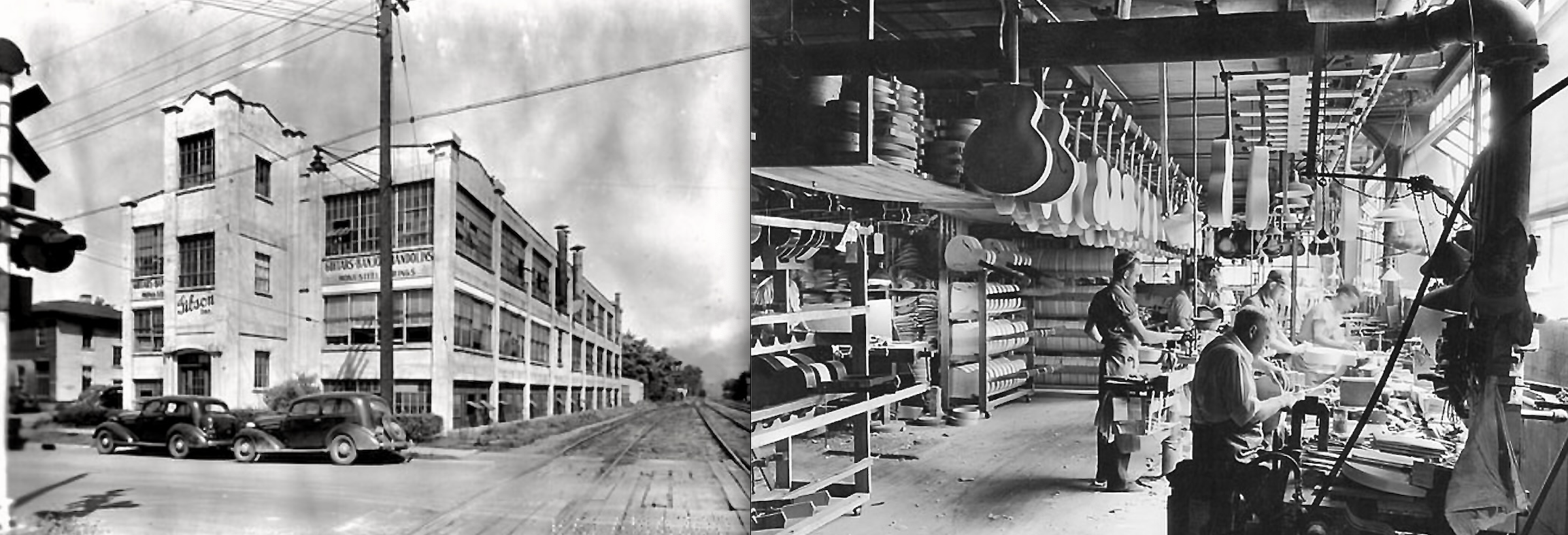
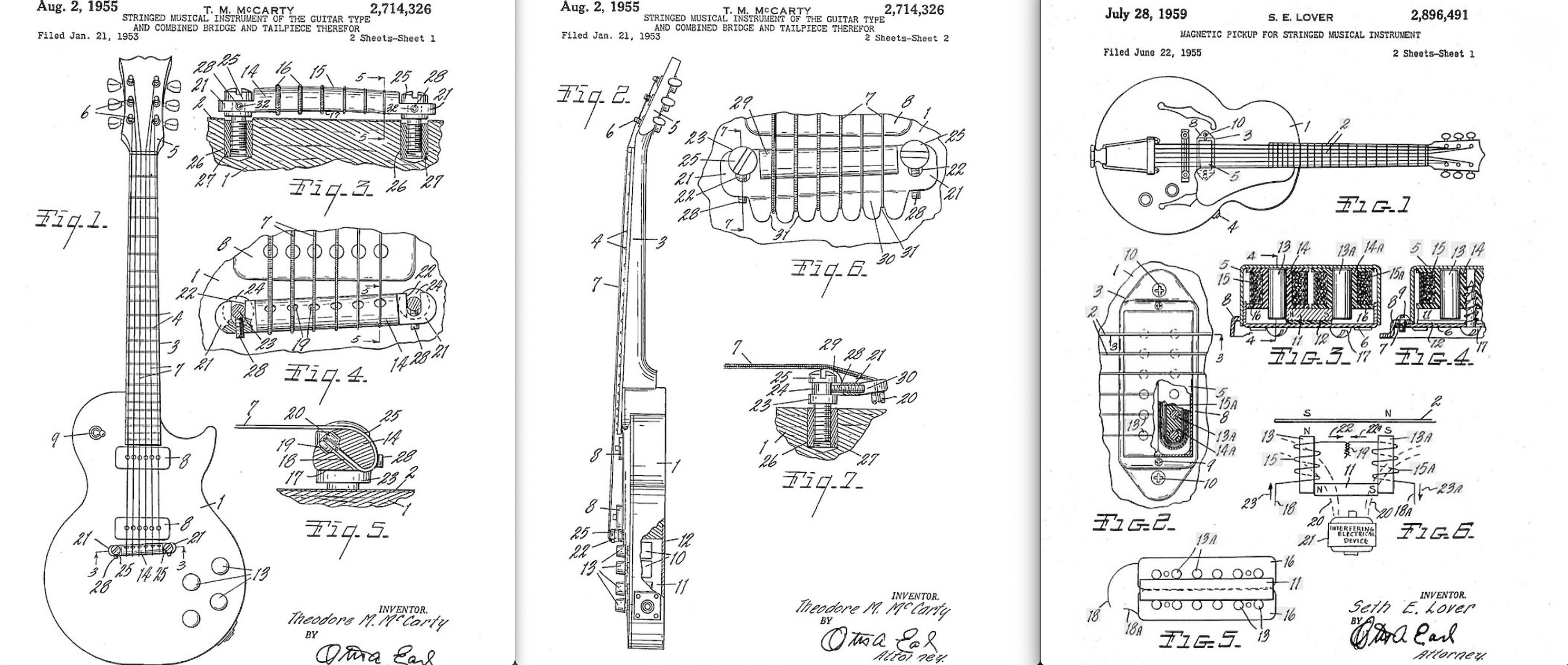
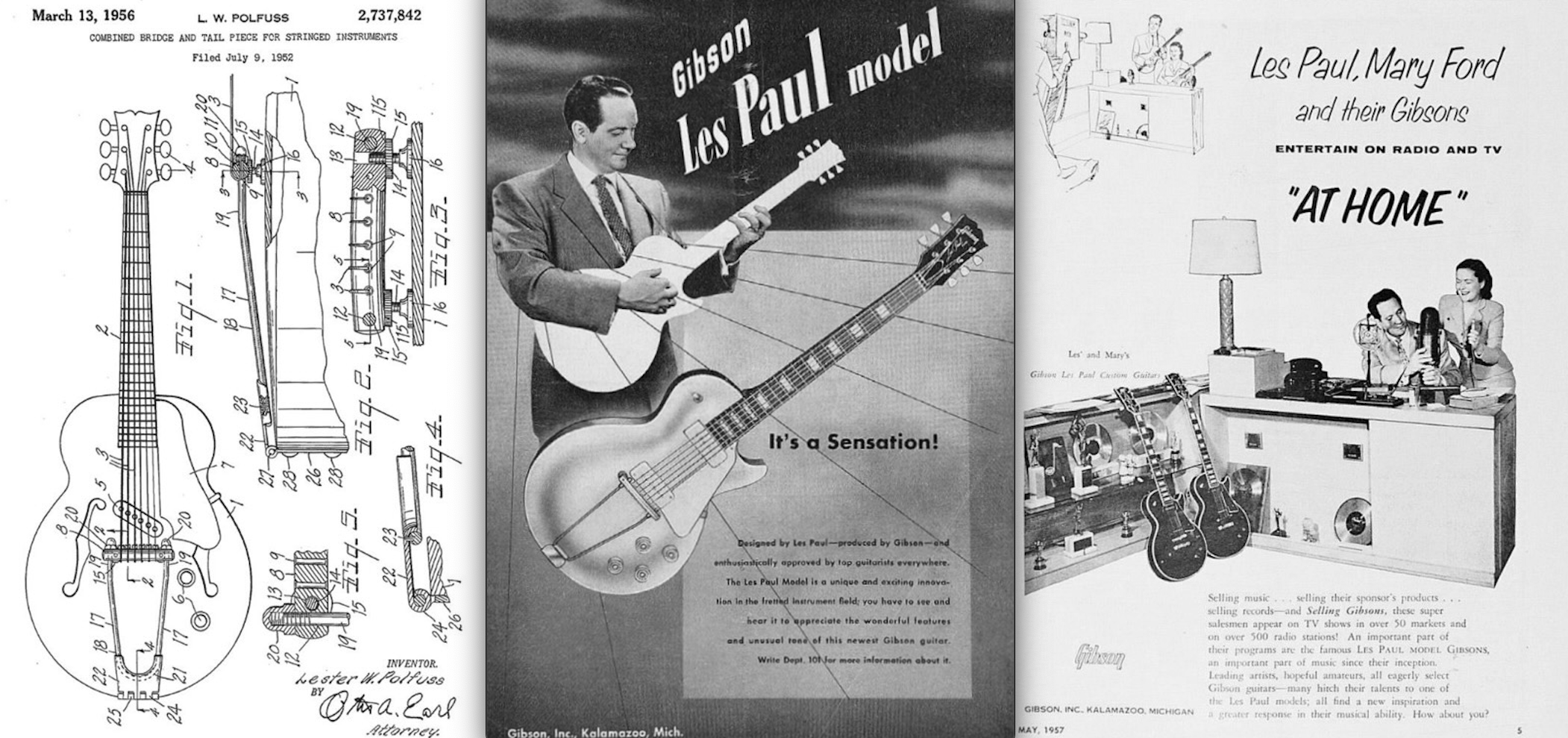
In the mid-1940s, Les Paul experimented with mounting pickups on a solid piece of wood. This to reduce the feedback that traditional arch top guitars with microphones suffered from. He took his 'log' to Chicago Musical Instruments (CMI), that owned Gibson. The reaction was laughter, CMI was not interested in Les Paul’s 'broomstick'. Years later Leo Fender developed a solid body guitar that later became the telecaster, and Gibson president at the time Ted McCarty could not ignore its success. Gibson now developed a solid body guitar and made a deal with Les Paul to use his name as its trademark. Les Paul and Gibson decided on a gold finish instead of the traditional sunburst. The first bridge-and-tailpiece was designed by Les himself.

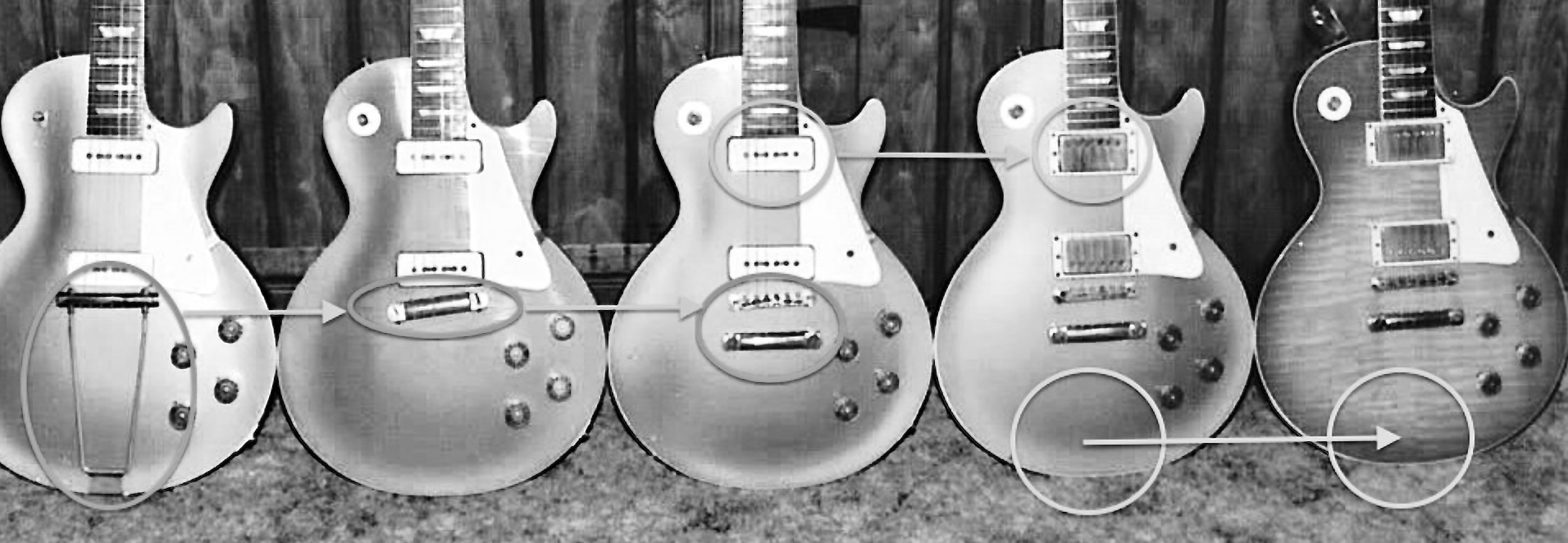
("Les Paul Evolution" Photo by Anonymous, uploaded by Unknown, n.d., www.lespaulforum.com)
The Les Paul Model
- Introduced mid 1952
- Carved 3 piece maple top
- Mahogany back and neck
- 2 soapbar P-90 pickups with cream-colored covers
- Trapeze bridge/tailpiece combination with strings looping under bridge
- Chicago capacitors (very early trapeze era)
- Grey Tiger capacitors (up to middle 50s)
- SIngle-bound top, binding inside cutaway same depth as binding around rest of top
- Single-bound rosewood fingerboard (earliest with unbound fingerboard)
- Trapezoid inlay, pearl logo, silkscreen Les Paul signature and model on peghead
- Kluson 'no line' tuners
- Plastic keystone tuner buttons with single ring near tuner shaft
- Yellow silkscreen model name
- No serial number
- 17 degree headstock angle
- Nickel-plated hardware
- Gold top finish, some with gold back and sides
- A few with red top
- Serial #. None
- Shipping Tot. 1716
1953
- Mid 1953 serial number on back of peghead
- Late 1953 Stud bridge/tailpiece
- Serial #. 3 xxxx
- Shipping Tot. 2245
- Serial #-54. 4 xxxx
- Shipping Tot. 1504
1955
- Mid to late 1955 Tune-o-matic bridge
- 1956 Bumble Bee (1gen) capacitors
- Kluson Deluxe 'single line' tuners
- Serial #. 5 xxxx
- Shipping Tot. 862
- Serial #-56. 6 xxxx
- Shipping Tot. 920
1957
- Mid 1957 Humbucking pickups
- A few with all-mahogany body
- Serial #. 7 xxxx
- Shipping Tot. 598
1958
- Mid 1958 Renamed Les Paul Standard
- 2-piece bookmatched maple top
- Cherry sunburst finish
- Serial #. 8 xxxx
- Shipping Tot. 434
1959-60
- Mid 1959 Jumbo frets by #9 0348
- Late 1959 Bumble Bee (2gen) capacitors
- 1960 Slimmer neck
- Black Beauty Sprague (3gen) capacitors
- Late 1960 Astron capacitors
- Late 1960 Metal caps on tone and volume knobs
- Kluson Deluxe 'single line' tuners with double ring buttons
- Serial #. 9 xxxx
- Shipping Tot. 643
- Serial # -60. 0 xxxx
- Shipping Tot. 635
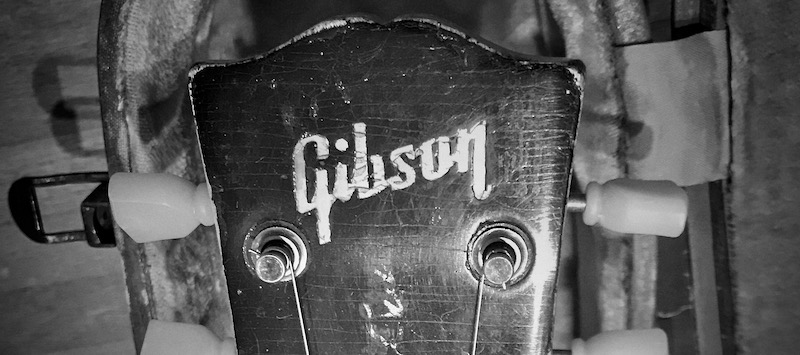
Les Paul 'low position' logo 1954
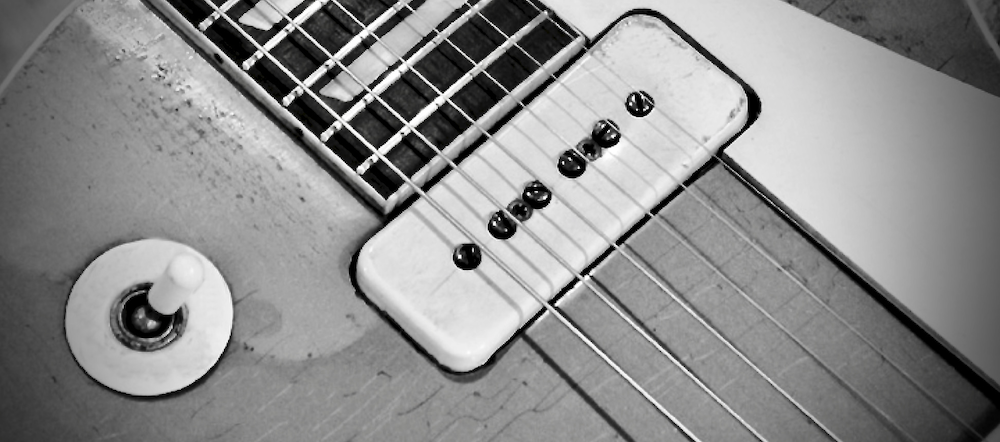
P-90 'soapbar' pickup
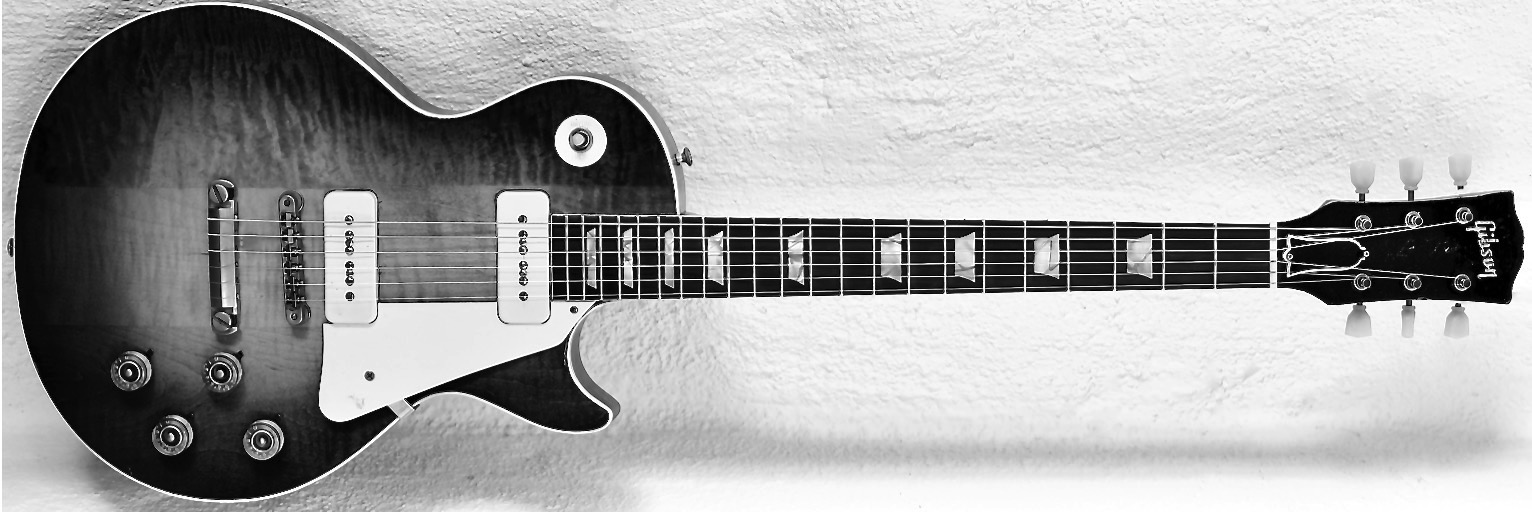
Les Paul 1954 refin Sunburst -56 specs
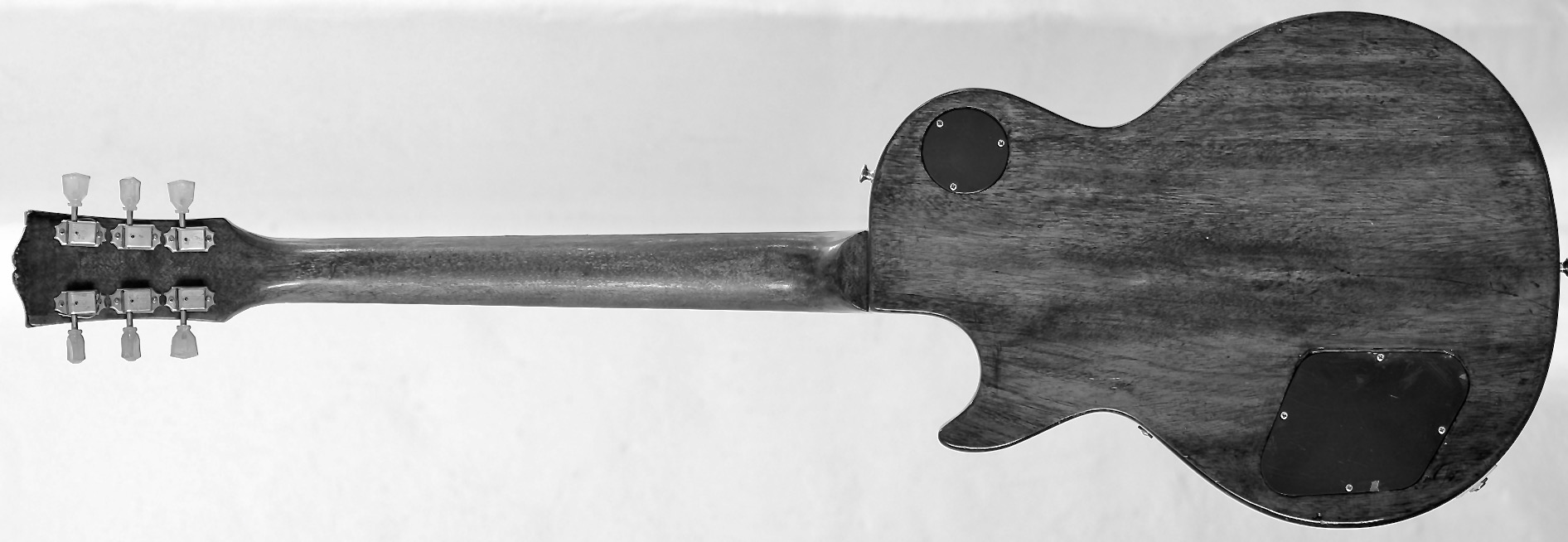
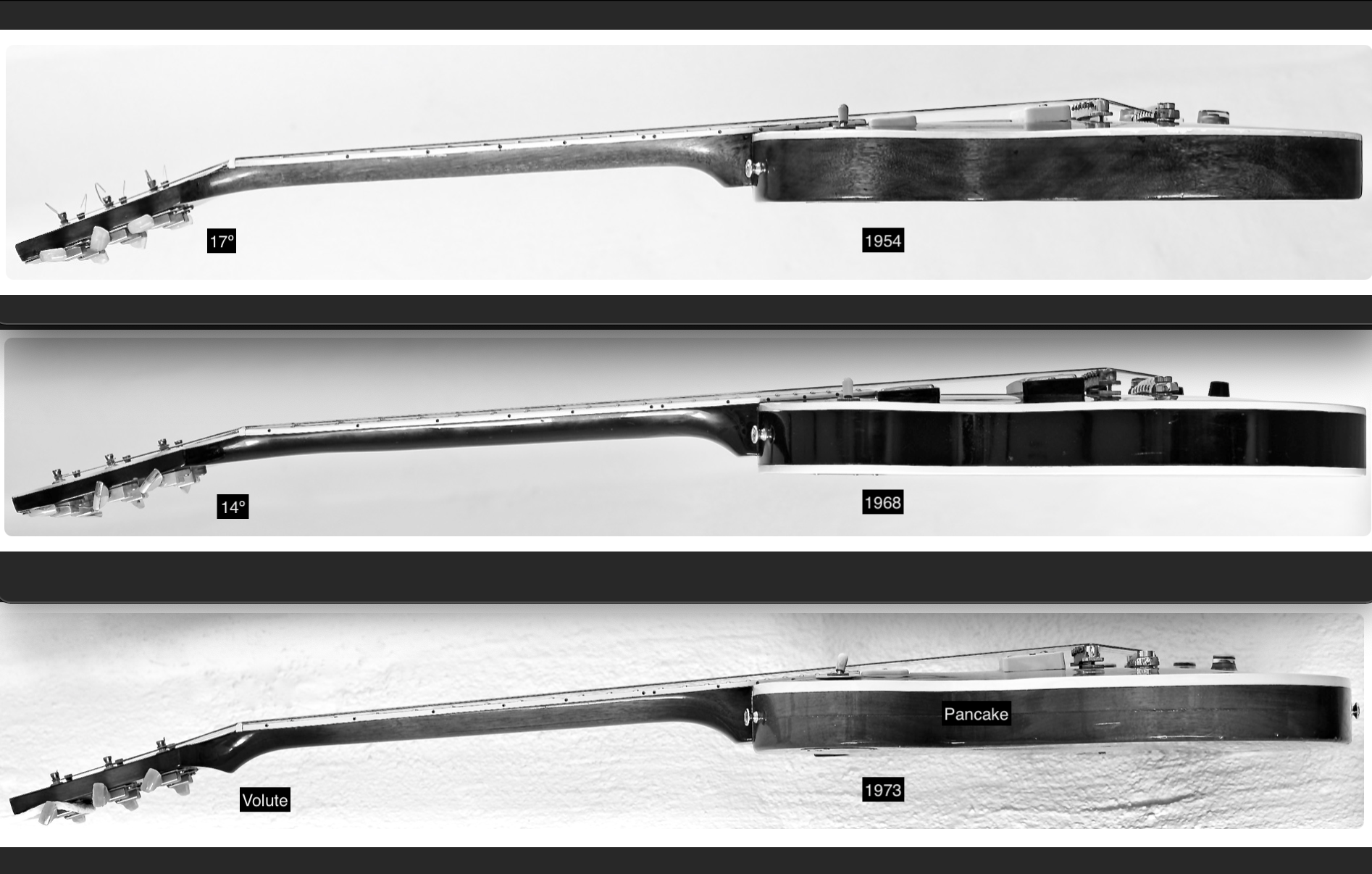 Neck angles 50-60-70
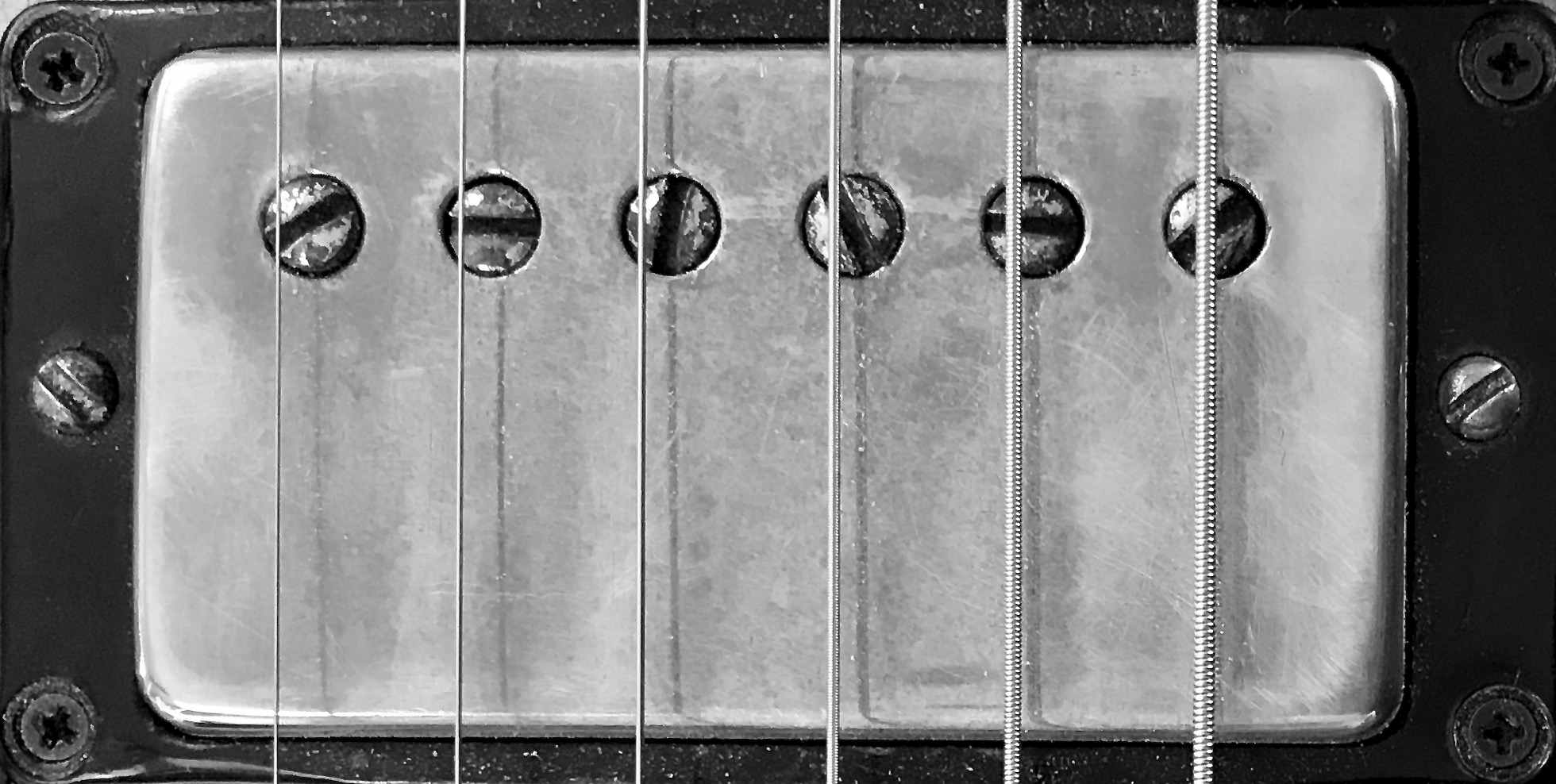
P.A.F pickup
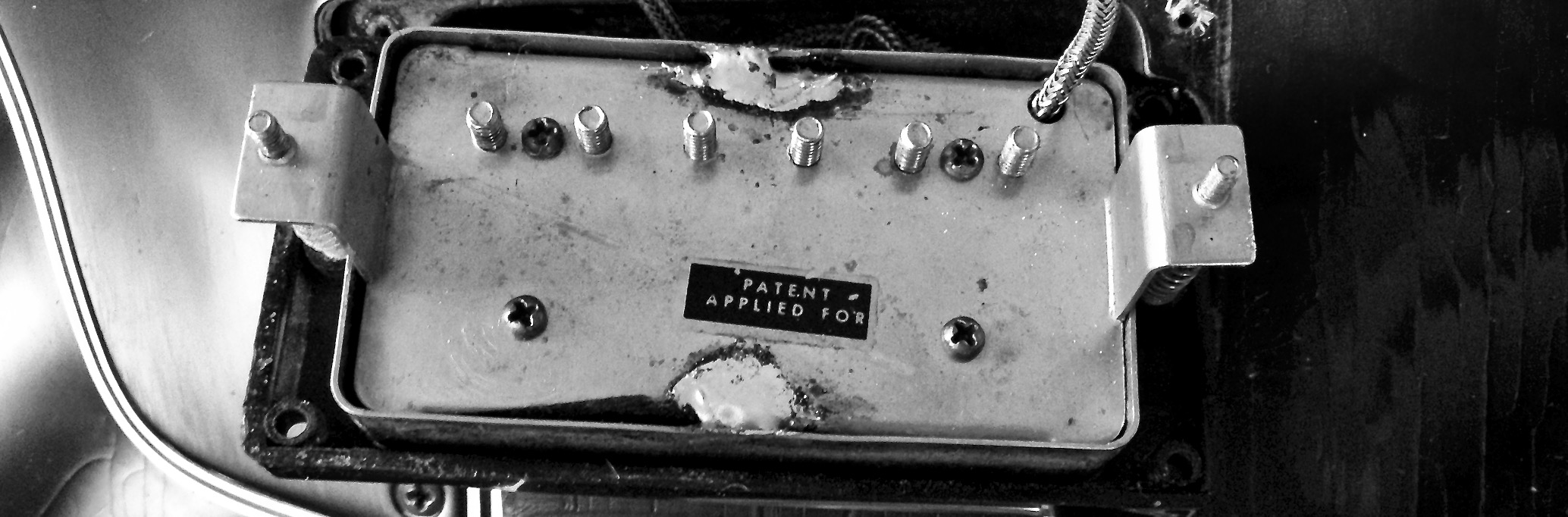
P.A.F sticker
Les Paul Custom
- (The Black Beauty) Introduced late 1953
- Early examples have no serials
- Later 1954 Yellow inked serials
- 1-piece mahogany body with carved top
- Alnico V neck pickup
- Black soapbar P-90 bridge pickup
- Tune-o-matic bridge, stop tailpiece
- Bigsby optional
- Multiple bound top and back
- Single bound ebony fingerboard
- Pearl block inlays
- Same size block inlays between the 16th & 17th, 18th & 19th & the 20th & 21st frets
- Fretless wonder frets
- Les Paul Custom truss rod cover
- 5 piece split diamond peghead inlay
- Closed back Klusons with plastic tulip shaped tuner buttons
- Gold plated hardware
- Ebony finish
1957
- Mid 1957 3 P.A.F pickups
- A few with 2 P.A.Fs
1959
- Grover Rotomatic tuners
- Early 1961 Last examples of single cutaway Customs before SG body
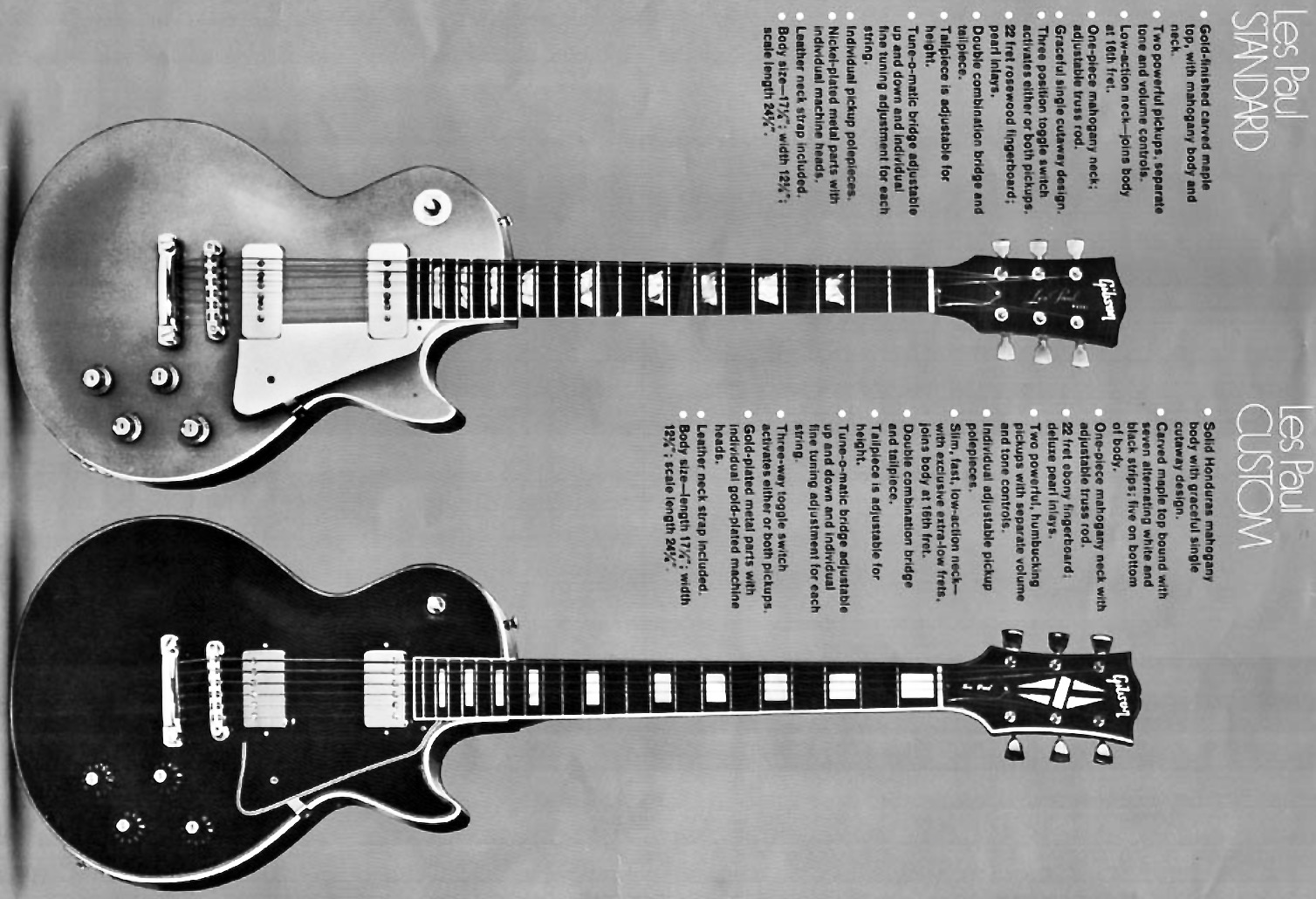
First reissue Les Paul Standard 1968
- 14 degree headstock angle
- 2-piece top
- Soapbar pickups
- Tune-o-matic bridge
- Deeper binding inside cutaway (a few early ones with 50s cutaway binding)
- 1950s style small peghead
- Stamped serial number
- Chrome parts
- Long neck tennon
- Control cavity route before maple top glued on
- Gold top finish
- Kluson Deluxe 'double line' tuners with double ring buttons
1969
- Early 1969 wider peghead
- Control cavity routed 50s style
- Early 1969 pancake body with thin maple layer close to top of body
- Mid 1969 maple layer in the middle of the mahogany pieces
- Dot in peghead logo disappears
- Neck tenon shorter
- Discontinued
1970
- Les Paul Deluxe
- Made in USA beneath serial number
- Volute on the back of neck nut
- Three piece laminate mahagony neck
- Three and four piece maple top
- Mini-Humbucker pickups
- Gibson Deluxe 'double line' tuners with double ring buttons
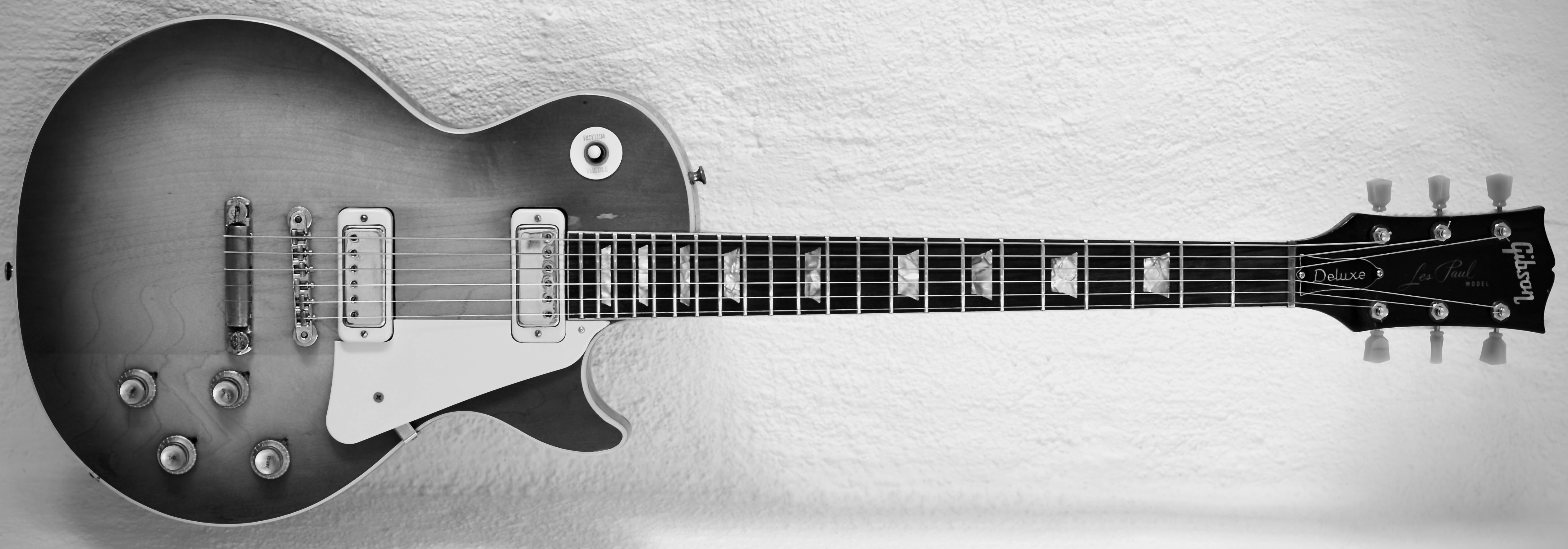
Les Paul Deluxe 1972, Mini-Humbuckers.
- Shipping Tot. Masses!
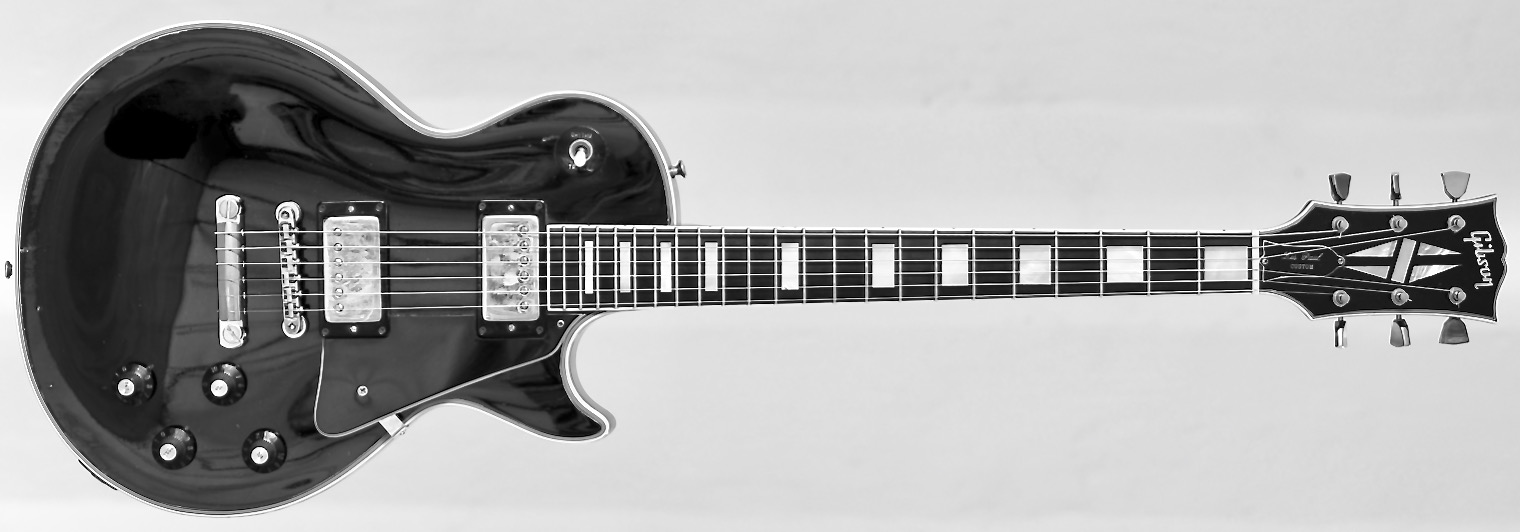
First reissue Les Paul Custom 1968
- 14 degree headstock angle
- Long neck tennon
- 7-ply top binding
- Two humbucking pickups
- Amp style knobs
- Control cavity route before maple top glued on
- Black Beauty Sprague capacitors
- Low frets
- Les Paul on truss rod cover
- Gold plated hardware
- Black finish
- Maple top
- Shipping Tot. 433
1969
- 2 layer mahogany, thin maple layer in middle, maple top
- Control cavity routed 50s style
- Dot in peghead logo disappears
- Neck tenon shorter
- SG-era brown ceramic disc capacitors
- Late 1969 Made in USA beneath serial number
- Late 1969 Three piece laminate neck
1970
- Neck volute
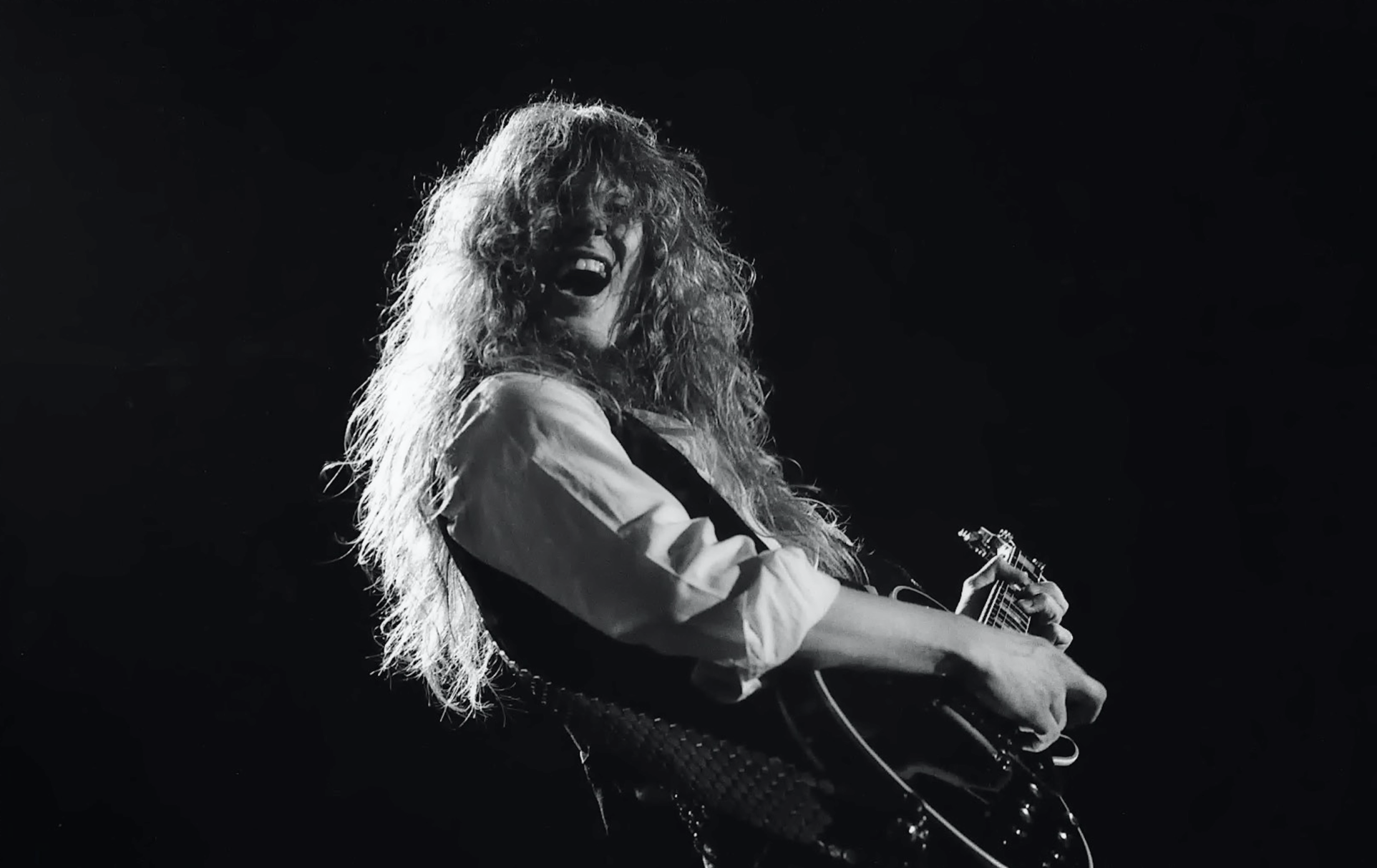
John Sykes 70's LP Custom.
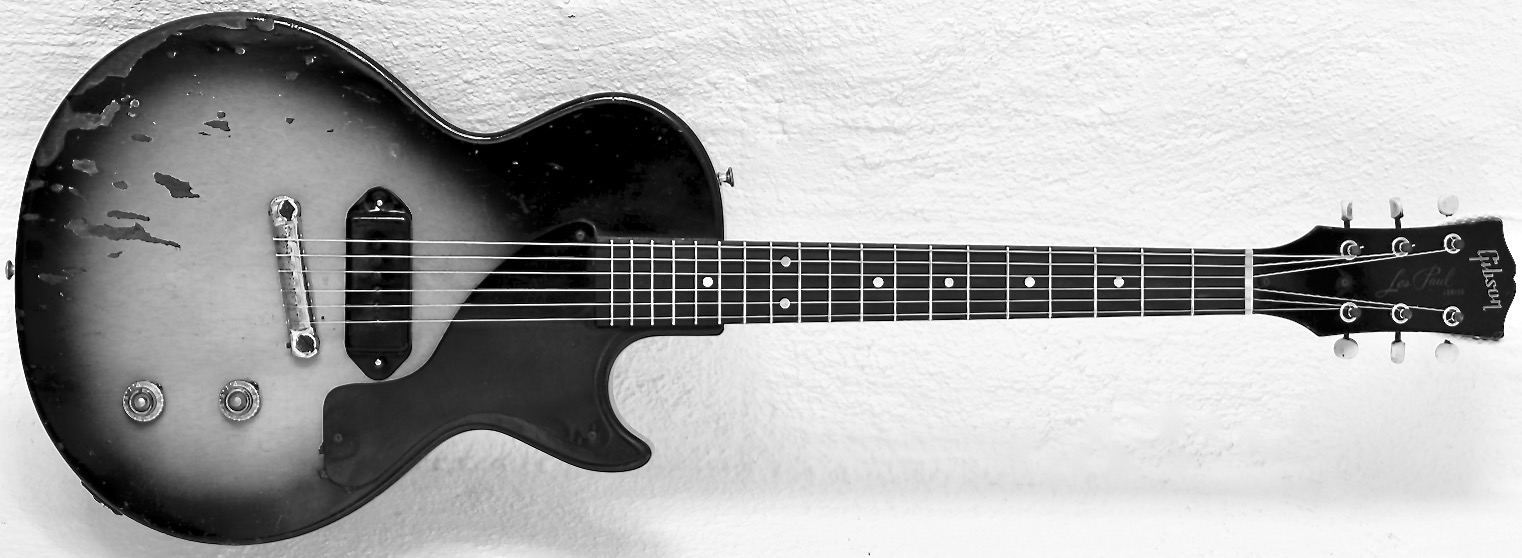
Les Paul Junior
- LP Jr introduced Mid 1954
- Slab mahogany body
- Single cutaway
- 1 black P-90 pickup
- Stud-mounted bridge/tailpiece
- Pickup close to the bridge
- Tortoiseshell plastic pickguard
- Gold barrel 'speed' knobs
- 16 frets clear of body
- Unbound rosewood fingerboard
- Dot inlays
- Yellow silkscreen logo
- Serial number color yellow inkstamp
- Nickel plated hardware
- Sunburst
- 1955 TV model avail.
- 1955 Bonnet knobs
- 1956 Post inserts increased in length and pickup moved slightly towards neck
- Mid 1956 'single line' Klusons
- (1954) 1956 Les Paul Jr. ¾ size, same body, shorter 22¾ scale neck, 14 frets clear of body
Mid 1958
- Double cutaway with rounded horns
- Sharpe body edge, single cutaway style
- 22 frets clear of body
- Cherry red finish
- Slightly different pickguard shape, some ex. early 1958
- Serial number color black inkstamp, some yellow
- Single ply tortoise pickguard
- Some ex. black pickguard until 1960
- Black bonnet knobs
- Early 1959 More rounded edges
- Some cherry single cutaways (rare)
- Spring 1959 larger frets
- Mid 1960 Silver reflector bonnet knobs
- Les Paul Jr. ¾ size, double cutaway with rounded horns, 15 frets clear of body
Early 1961
- SG body
- Laminated pickguard
- Les Paul Junior on peghead
- Early ex. had slant bridges. 2gen straight tailpiece comp. 'stairstep' 'lightning bolt' wrap around
- Cherry and TV finish
- 1962 Maestro vibrato optional
- Late 1963 Renamed SG Junior
- Gibson transitioned from the limed mahogany finish to the Polaris White finish on the SG Junior TV guitar around 1963
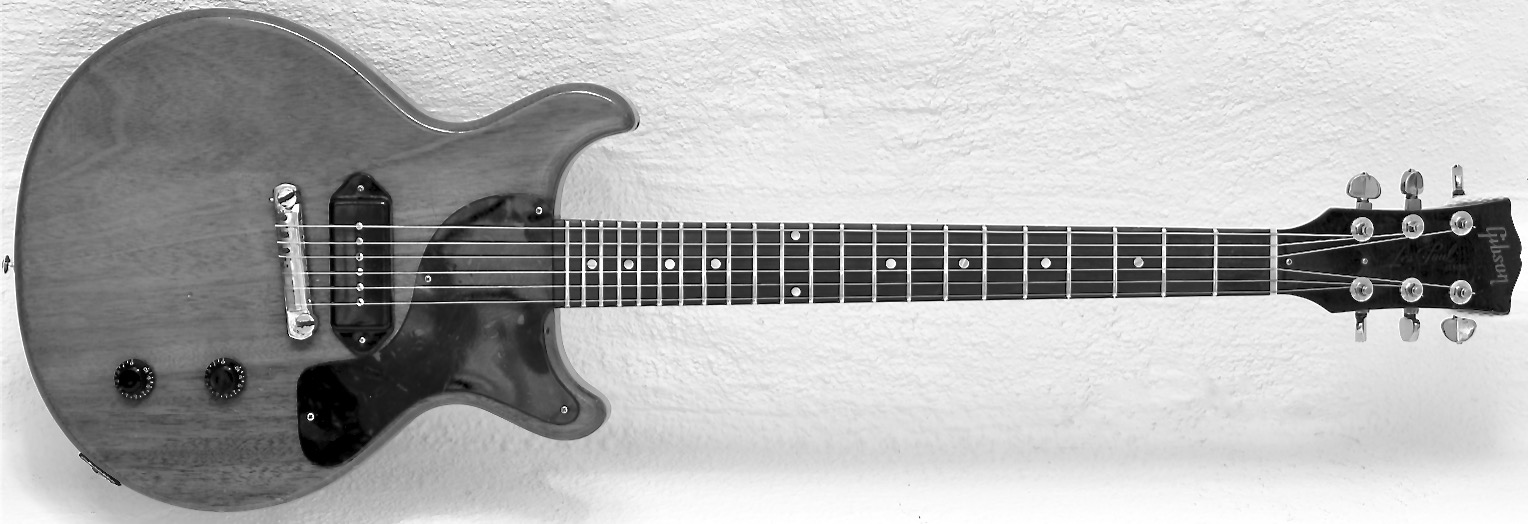
Les Paul Junior 1960
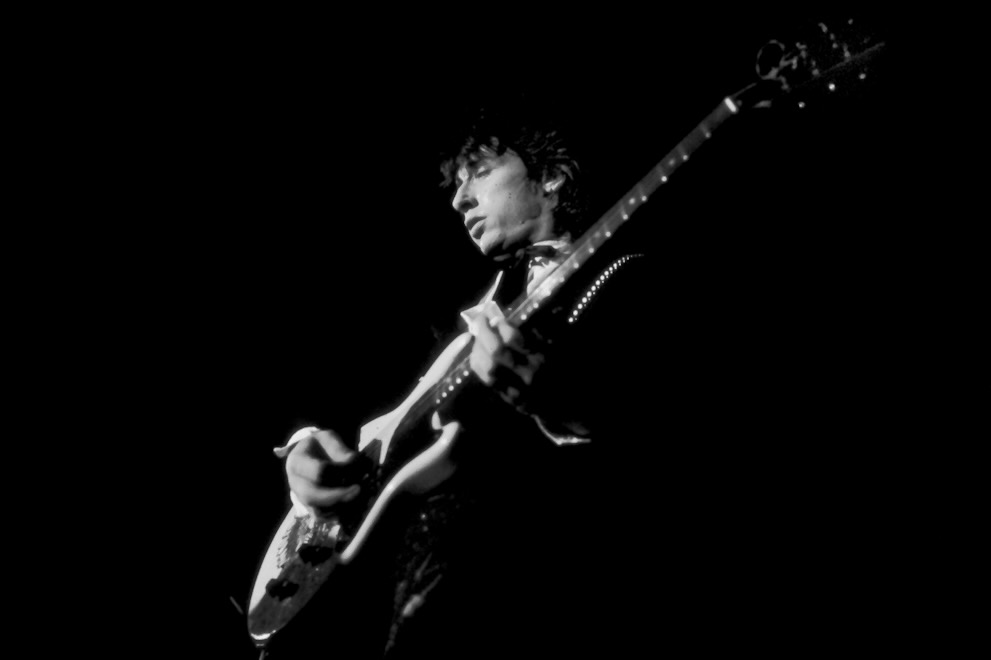
Johnny Thunders LP TV Junior.
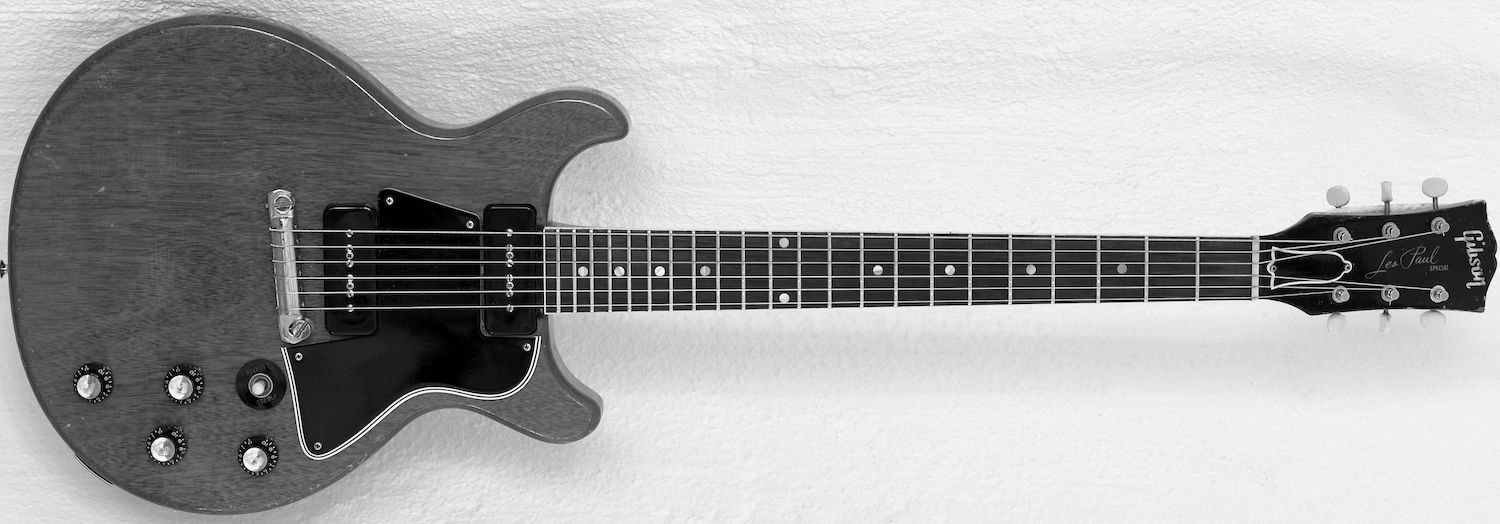
Les Paul Special
- Introduced 1955
- Flat top slab single cut
- 2 black soapbar P-90s
- Neck pickup wery close to fingerboard
- Stud bridge/tailpiece
- Laminate beveled edge PG
- Switch on upper bout
- Single bound rosewood board
- Dot inlays
- Pearl logo + yellow silkscreen model name
- Nickel plated hardware
- Limed mahogany finish
- A few early ex. with natural finish (rare)
- 1956 Post inserts increased in length
- 1958 Larger switch hole with rubber washers on some ex.
- 1959 Les Paul Special ¾ size, same body as double cutaway Les Paul Special, shorter scale, 15 frets clear of body, cherry finish
Mid 1958-1959
- Double cutaway with rounded horns
- Switch away from bridge
- 22 frets clear of body
- Cherry red finish, 'TV' beige finish optional
- Mid 1959 Neck pickup space to fingerboard
- Switch moves near bridge
- Late 1959 Renamed SG Special (some ex. Les Paul Special on head into -60)
- Late 1959 Les Paul Special ¾ size renamed SG Special ¾
- Late 1959/1960 'Les Paul Special' removed from peghead and left blank on some ex.
1961
- Some 1961 double cutaway/rounded horns and 1961 serial (1 xxxx) (rare)
- Some 1961 double cutaway/rounded horns and 1961 new serial scheme (early numbers) (rare)
- Transition to SG body
- Les Paul Special reissued in 1976 'Caveat Emptor'
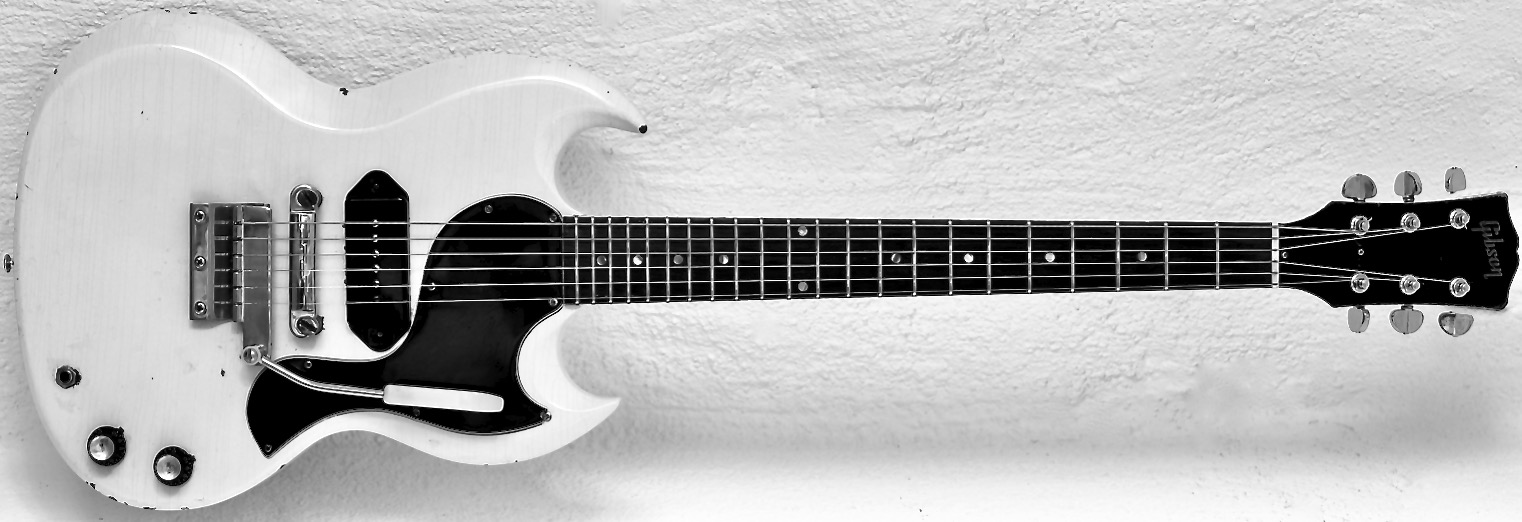
SG Polaris White (TV) Junior 1965
Gibson SG
Gibson introduced the SG in 1960, a successor to the Les Paul. The SG had a modern, streamlined look with sharp edges and angles, making it easier to reach higher frets. The acronym SG stands for Solid Guitar, distinguishing it from the Les Paul design.
SG/LP Standard
- Very late 1960 SG body shape
- Les Paul Model on peghead
- Side pull Deluxe Gibson vibrato
- Cherry finish
- 2 P.A.F. pickups
- 3 layer black beveled small pickguard
- Nickel plated parts
- Thin neck shape
- Mid 1961 Les Paul on truss rod cover
- Crown peghead inlay
- 1962 Some with pearl inlaid ebony tailblock (rare)
- Late 1963 Renamed SG Standard
- Kluson Deluxe 'single line' tuners with double ring buttons
1963
- Late 1963 Renamed SG Standard
- Maestro vibrato with lyre + coverplate logo
- Pat. # humbucking pickups
- No Les Paul on truss rod cover
- Neck shape slightly larger
- Increased neck tenon size
1965
- Transition period mixed specs
- Chrome parts
- 14 degree neck angle
- Larger pickguard, no pickup frames
- Narrow nut width
- Kluson Deluxe 'double line' tuners with double ring buttons
- 1966 Indian rosewood fingerboard
- 1971 Replaced by SG Deluxe. Standard reintroduced 1972
- Gibson Deluxe 'double line' tuners with double ring buttons
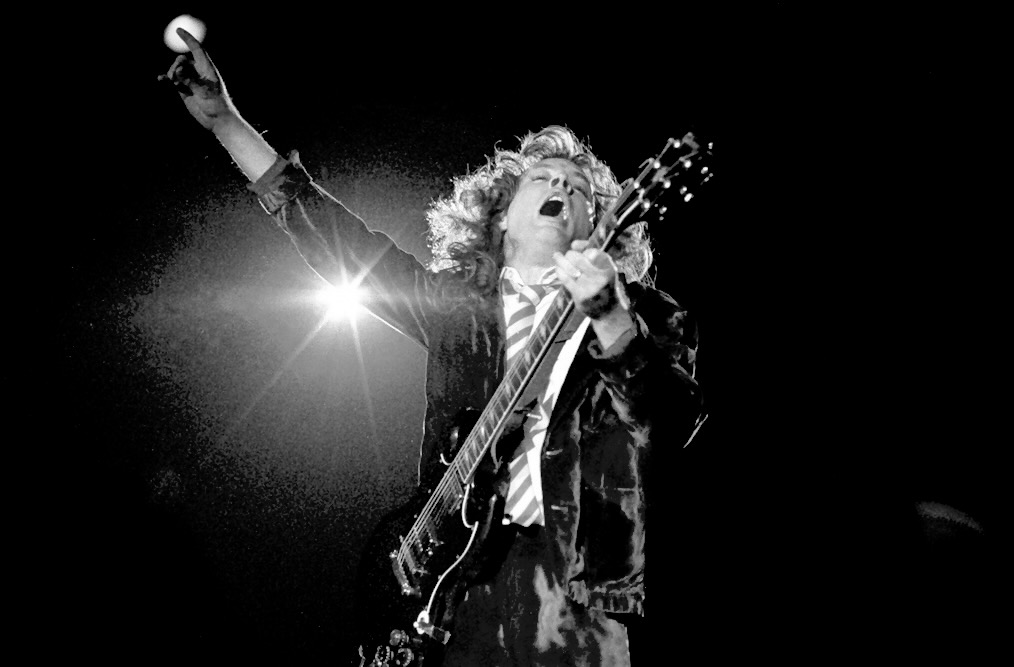
Angus Young Late 60's SG Standard.
Gibson ES-335 (345, 355, 330)
With the ES-335 Gibson surely took inspiration from ’The Log’ Les Paul’s early attempts to produce a solid body guitar. In 1958 Gibson under Ted McCarty came up with a guitar that was different from other ES models. The 335 was the first semi-solid guitar that had a central wooden block hidden beneath what looked like an ordinary ES arch top thin line guitar.
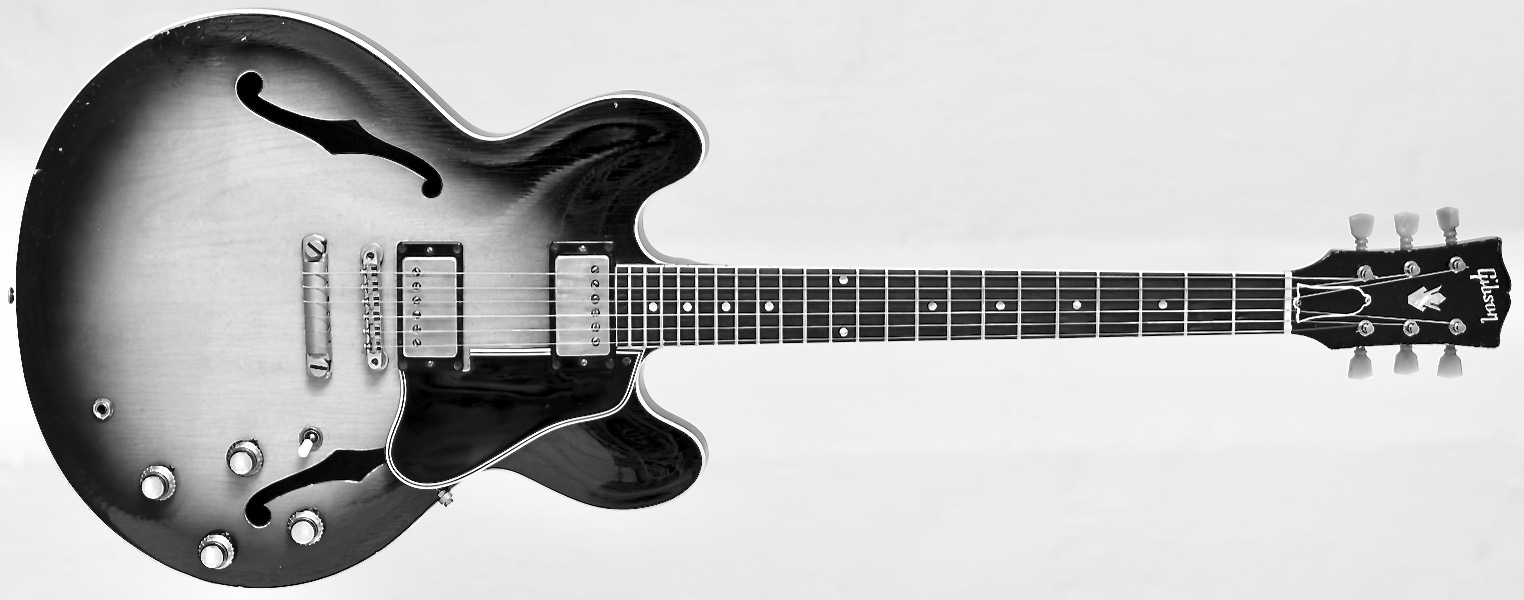
ES-335 TD
- Introduced spring 1958
- Semi-hollowbody electric arch top
- 2 humbucking pickups
- Tune-o-matic bridge, stop tailpiece
- Bigsby vibrato optional
- Laminated beveled-edge pickguard extends below bridge
- Single-bound top and back
- Neck-body joint at 19th fret
- Single-bound rosewood fingerboard
- Dot inlays
- Crown peghead inlay (early with unbound fingerboard and no peghead ornament)
- Sunburst or natural finish
- Plastic strap buttons
- 17 degree headstock angle
- Serial #. A 26820 (Jan 6) A 27816 (Jul 1) A 28576 (Dec 1) A 28880
- Shipping Tot. 267 TD
- Shipping Tot. 50 TDN
1959
- Late 1959 Cherry finish optional
- Serial #. A 28881 (Jan 9) A 30569 (Jul 13) A 31844 (Dec 2) A 32284
- Shipping Tot. 521 TD
- Shipping Tot. 71 TDN
1960
- Slimmer neck
- Metal caps on tone and volume knobs (shallow post hole)
- Mid 1961 and later knobs has deeper post hole
- Plastic tuner buttons with double ring
- Early 1961 Shorter pickguard does not extend below bridge
- 1961 White switch tip
- 1961 Metal strap buttons
- 1961 Serial number pressed on peghead and on orange label
- Mid-late 1961 A cut in the block for 345 Varitone is seen on 335s, by 1965 most bodies do
- Serial # -60. A 32285 (Jan 4) A 34068 (Jul 1) A 35252 (Dec 1) A 35645
- Serial # -61. A 35646 (Jan 3) A 35943 (Feb 1) A 36147 (Feb 21, Last A number)
- Serial # -61. 1 xxxx (very rare). 100-41199 (42440)
- Shipping Tot. -60. 405 TD
- Shipping Tot. -60. 88 TDN
- Shipping Tot. -60. 21 TDC
- Shipping Tot. -61. 466 TD
- Shipping Tot. -61. 420 TDC
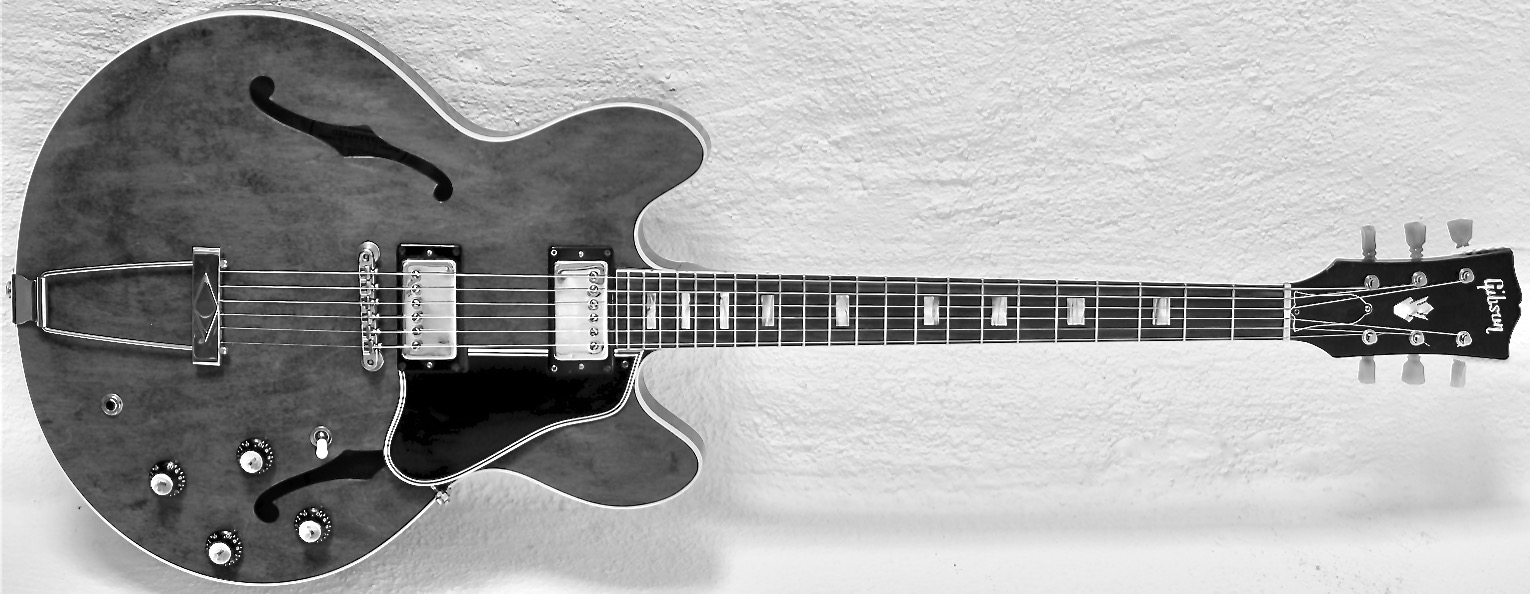
ES-335 Blockneck
- Mid 1962 Small pearloid block inlays
- Late 1962 Neck shape starts to increase in size
- Late1962 Patent number sticker pickups
- ~1963 'Mickey Mouse' ears shifts to a slightly pointier shape
- Serial # -62. (42441) 41200-61180, 71041-96600
1965
- Late 1964 Trapeze tailpiece (some with stop tailpiece in 1965)
- Lover position of the crown inlay post 1965
- 335-12 string in sunburst and cherry avail. 1965-70
- 1966 14 degree headstock angle
- 1966 Small nut width
- 1966 Indian rosewood replaces Brazilian rosewood
- 1966 Bevel on pickguard less noticible
- Some with single-parallelogram inlay: 1963, 1967, 1969
- Kluson Deluxe 'double line' tuners with double ring buttons
Late 60's and beyond
- Walnut finish optional: 1969
- 1968 increased nut width
- 1969-1974 Gibson Deluxe 'double line' tuners with double ring buttons
- Center block extends only from tailpiece to endpin: Dec. 1972–Aug. 1975
- Coil-tap switch on upper treble bout: 1977
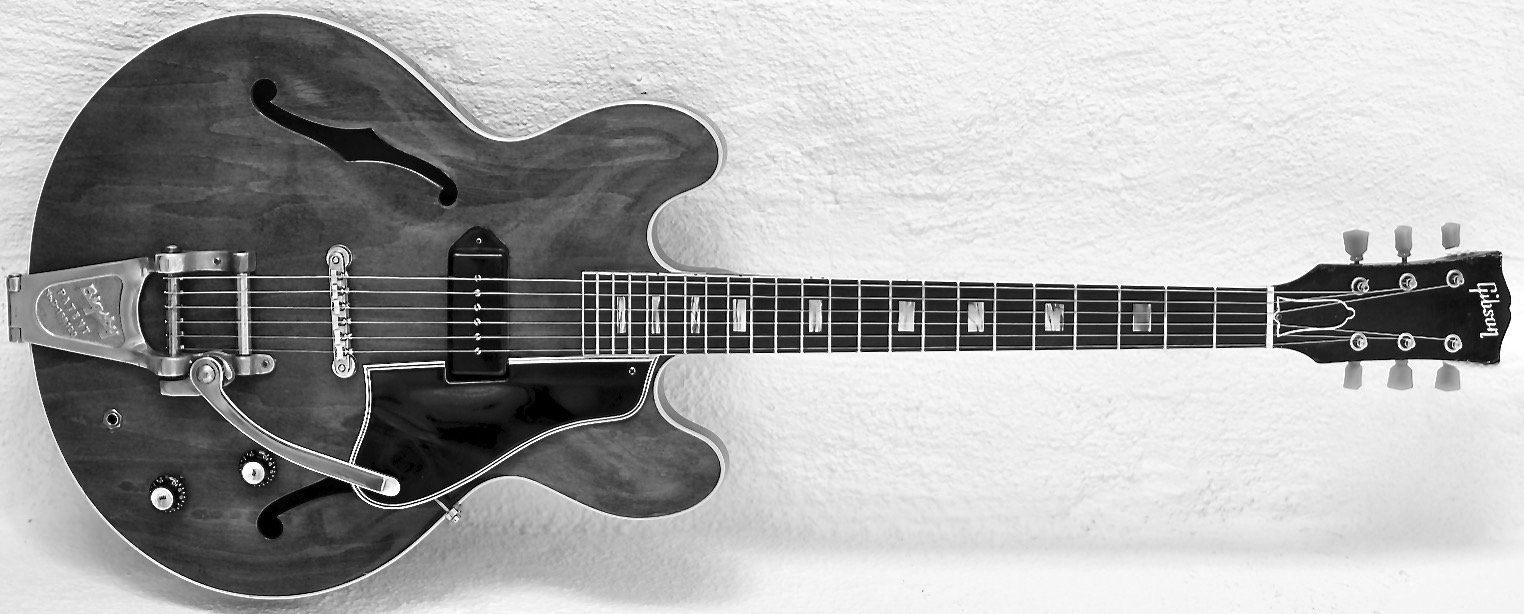
ES-330
- Introduced 1959
- Full hollow body
- Double rounded cutaways 'Mickey Mouse'
- Neck/body joint at 17th
- 2 black plastic-cover P-90s
- Tune o matic bridge
- Trapeze tailpiece
- Single bound top + back
- Bound fingerboard
- Dot inlays
- Pearl logo, no peghead ornament
- Sunburst or natural
- ES-330T Single P-90 in middle position (naturals very low in shipment totals)
1962
- Sunburst or Cherry finish, natural discontinued
- Nickel plated plastics pickup covers (rare) then nickle plated metal covers
- Block inlays
- Ears become more pointy
- ES-330T Single P-90 in middle position, sunburst or cherry (cherrys low in shipment totals)
1963
- ES-330T Single P-90 version discontinued (still with 'Mickey Mouse' ears)
- 1965 Chrome parts (including pickup covers)
- 1967-69 Sparkling burgundy optional
- 1968 Walnut optional
- 1968 Neck/body joint at 19th
- ES-330TD discontinued 1972
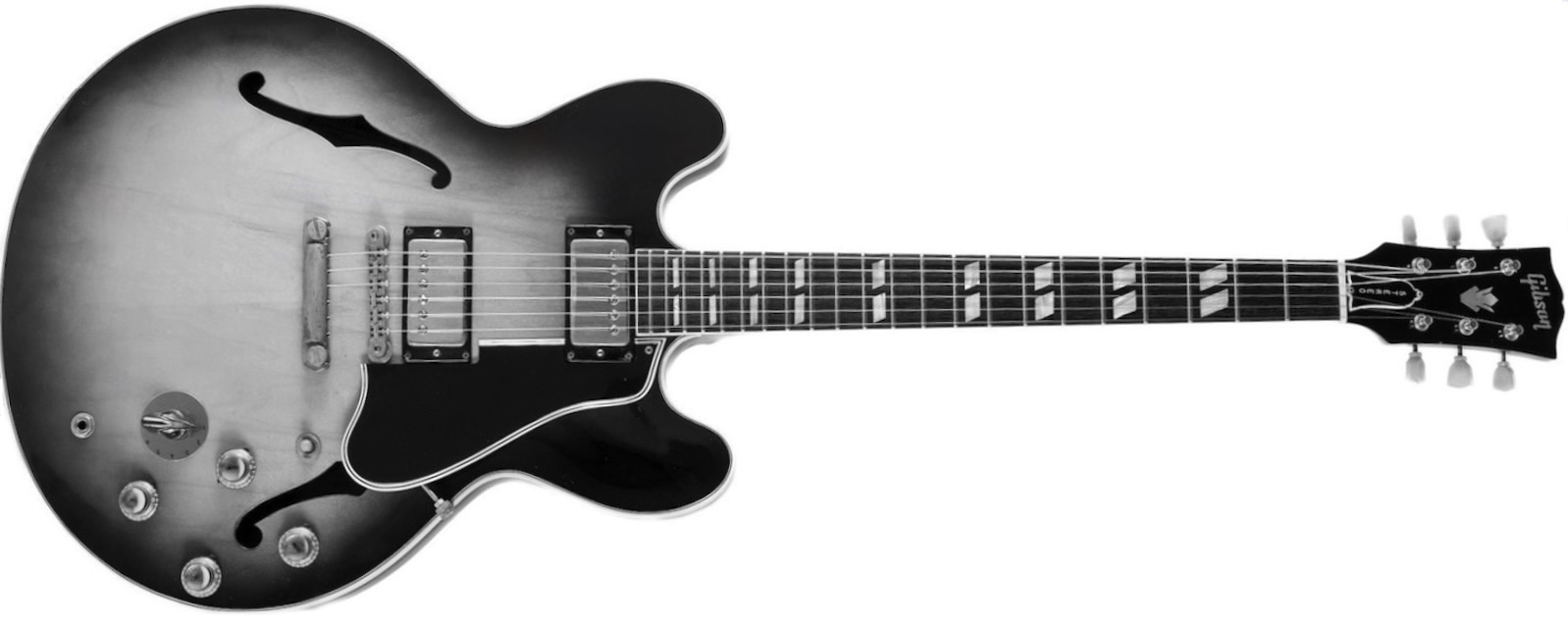
ES-345 TD
- Introduced 1959
- Stereo electronics Y-chord
- Black ring varitone selector
- Pickguard extends below bridge
- Triple bound top + bound back
- Neck body joint at 19th
- Double parallelogram inlays
- Crown peghead inlay
- Gold plated hardware
- Sunburst or natural
- Late 1959 Cherry finish optional
1960
- Gold ring varitone
- Natural discontinued
- Mid 1960 Shorter PG
1965
- Late 1964 Trapeze tailpiece
- 1969 Walnut optional
- Late -60s Gibson Deluxe style tuners
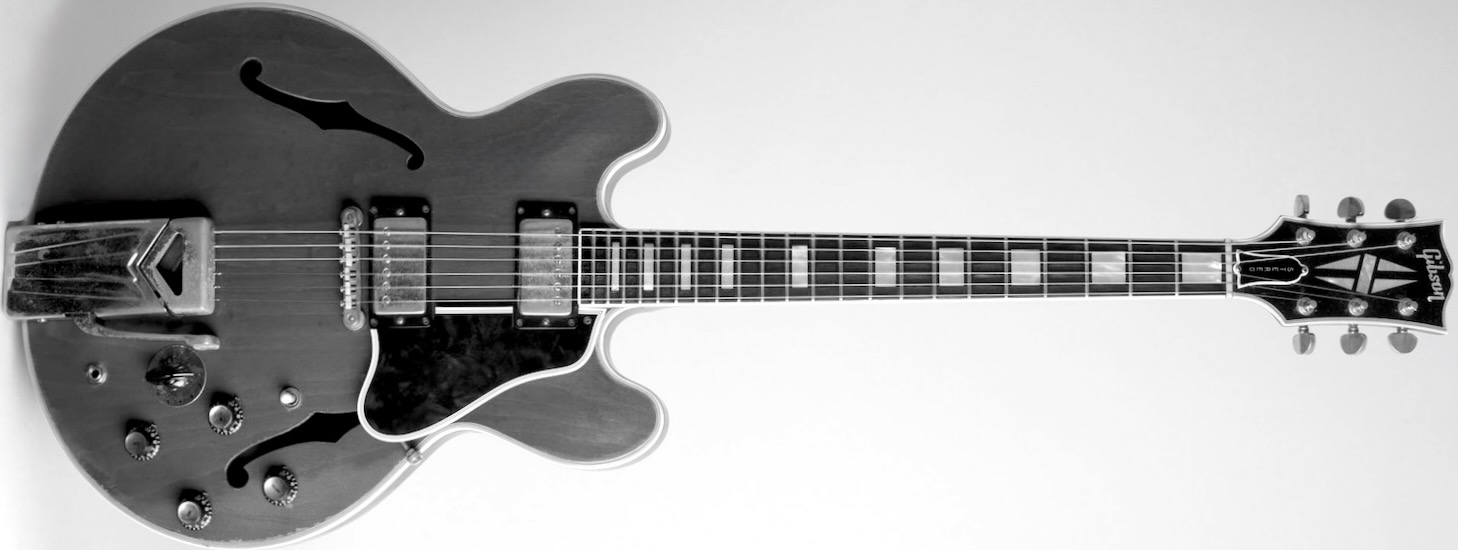
ES-355 TD
- Introduced 1958 (10 ex.)
- Mono circuitry
- Bigsby vibrato. Some ex. without vibrato (rare)
- Sidways vibrato optional
- PG extends below bridge
- Multiple bound top + triple bound back
- Unbound f-holes, some with bound f-holes
- Neck body joint at 19th
- Ebony fingerboard
- Large block inlays
- Multiple bound peghead
- Split diamond peghead inlay
- Grovers
- Cherry finish
1959
- Stereo electronics (ES-355TDSV) optional
- 1960 Shorter PG
- Sunburst and natural available
- 1961 Sideways vibrato standard
- Mono electronics (rare)
- 1961 Kluson tuners
- Some ex. with round varitone knob (rare)
1963
- Gibson vibrato with lyre on coverplate
- 1967 Grover tuners
- 1969 Walnut finish optional
- 1969 Bigsby
- 1970 Non-stereo, non-Vari-tone (ES-355TD) version discontinued
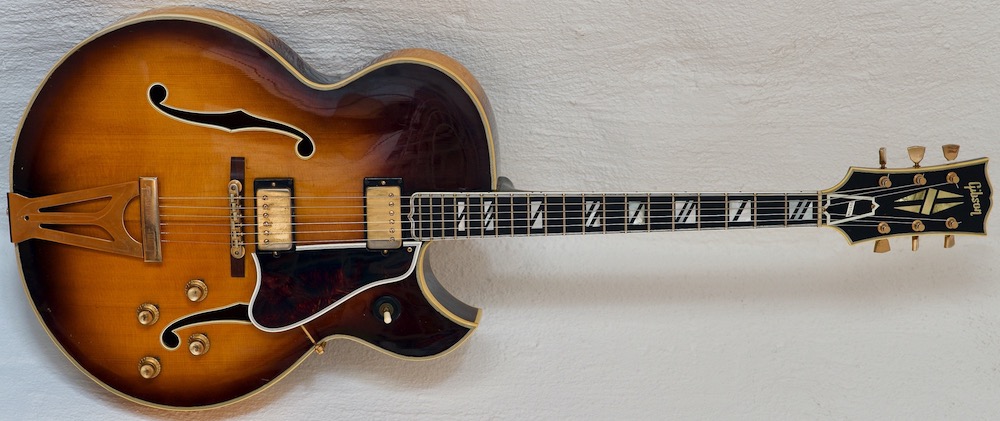
Super-400 CES
- Introduced 1951
- Electric version of the Super 400C archtop
- Rounded venitian cutaway
- Solid carved spruce top, carved maple back, maple sides
- 2 P-90 pickups
- Multiple bound top, back, f-holes, peghead, fingerboard (ebony)
- Split block fingerboard inlays
- 5 piece split diamond inlay on peghead
- Sunburst or natural
1954
- Alnico V pickups
- Late 1957 Humbucking pickups
1961
- Pointed florentine cutaway
- 1-piece laminated maple back, some ex. 2 piece laminated back
- 1969 Back to rounded venitian cutaway
- Solid 2 piece back
- Only 200 florentine cutaway sunbursts was produced from 1961 to 1968 according to A.R Duchossoir, naturals less than 100
Modernistic Guitars "Out of this World" in 1958
In 1958, Gibson introduced a series of guitars known as the Modernistic guitars, (Prototype or prototypes displayed at the 1957 NAMM Show (Explorer with a v-shape split head stock later known as the Futura)). These guitars were part of Gibson's effort to push the boundaries of guitar aesthetics. The Modernistic guitars featured avant-garde shapes that deviated from traditional guitar designs. Flying V: Known for its distinctive V-shaped body. Explorer: With unique angular design. Moderne: The Unproduced Model (one prototype was fully completed and documented), this model is often discussed among guitar collectors due to its intriguing mystery surrounding its non-production. The V and Explorer (Korina/Limba) are extremely low in production numbers and ceased production in 1959, with some produced in the early 60s using leftover parts. The V was reissued with a slightly different design (Mahogany + Cherry) in 1966. The Explorer was reissued in 1975 (Ebony, Natural, and White).
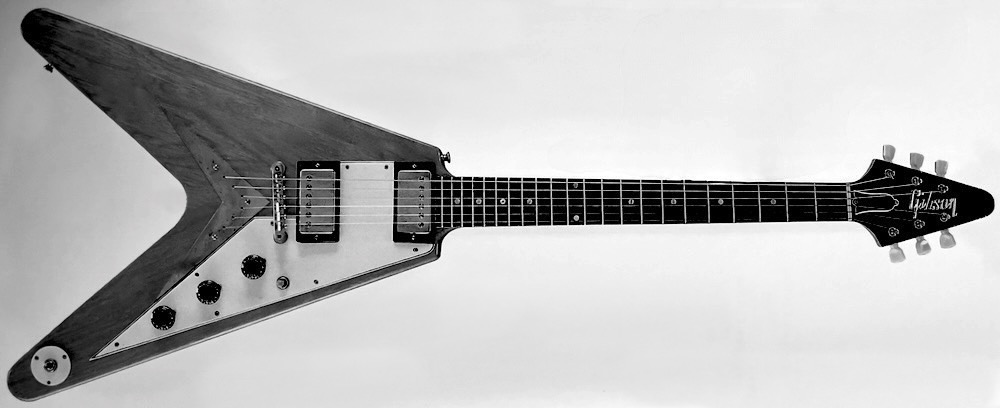
- Flying V
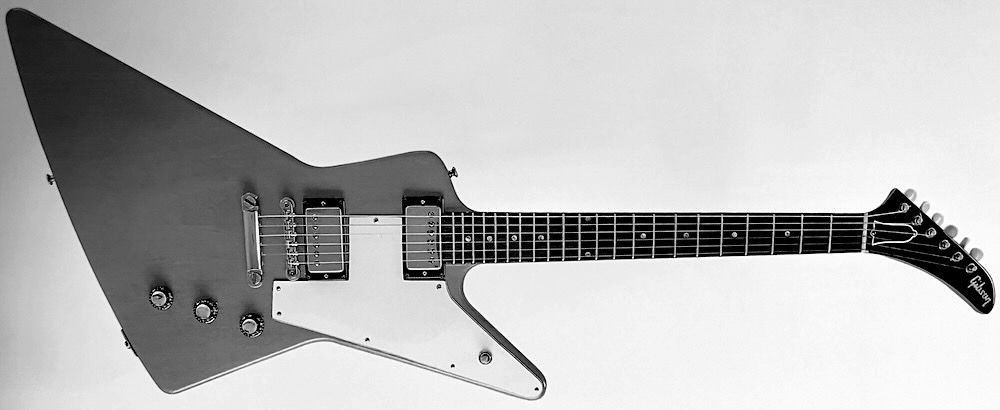
- Explorer
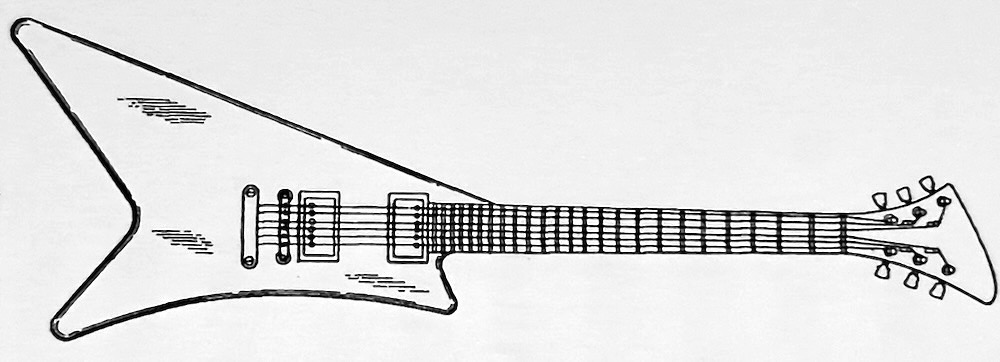
- Moderne
Firebird Series
Four reverse Firebirds with different appointments but the same build constructions and two matching Thunderbird basses were introduced mid-1963. Neck-through body construction with side wings. Mini-humbucking pickups with metal cover and metal mounting ring, no adjustable poles. 3-ply white pickguard, large Kluson banjo-style tuners, nickel-plated or gold-plated parts, sunburst finish, custom colors optional. 1963 has no engraved Firebird on the pickguard. 1964 and later, red engraved Firebird on the pickguard. Transition Firebirds during the summer of 1965 with mixed reverse and non-reverse features. Non-reverse style and P-90 pups in 1965, custom colors available. Discontinued in 1969.
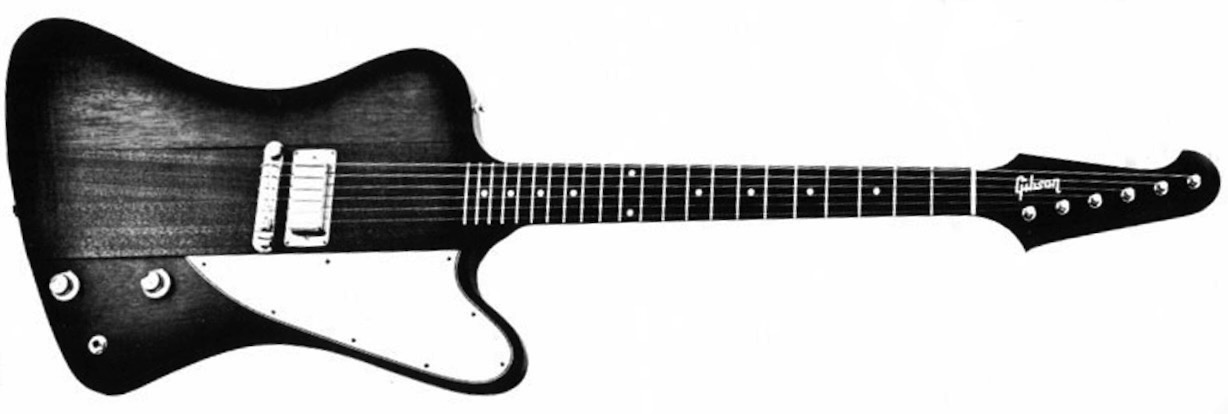
- Firebird I
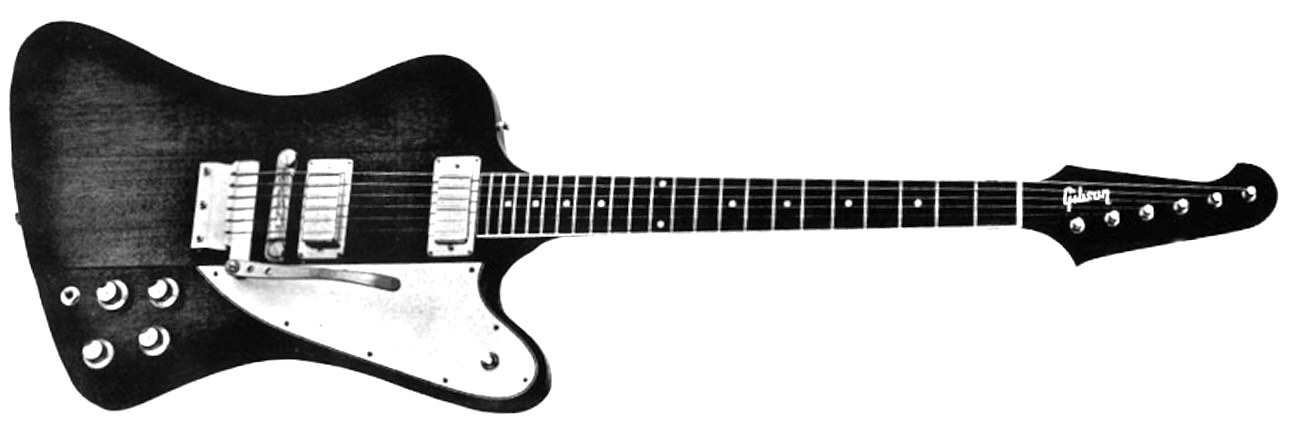
- Firebird III
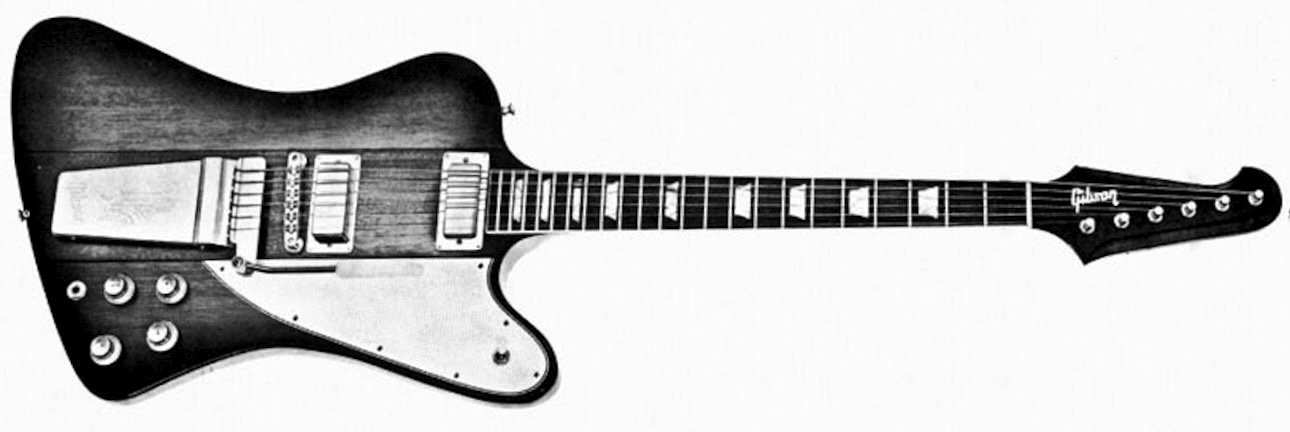
- Firebird V
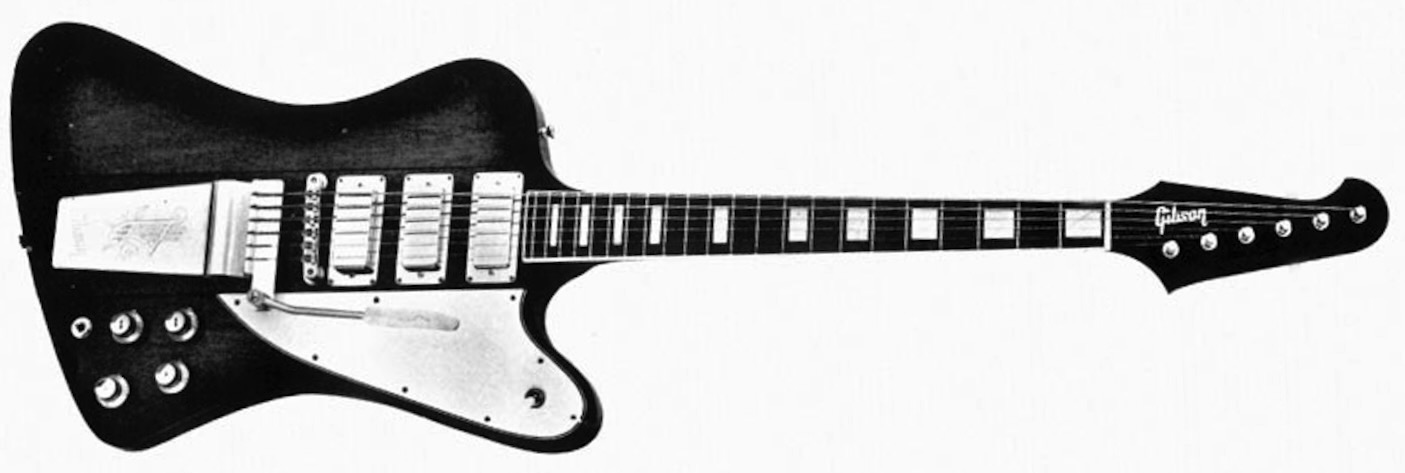
- Firebird VII
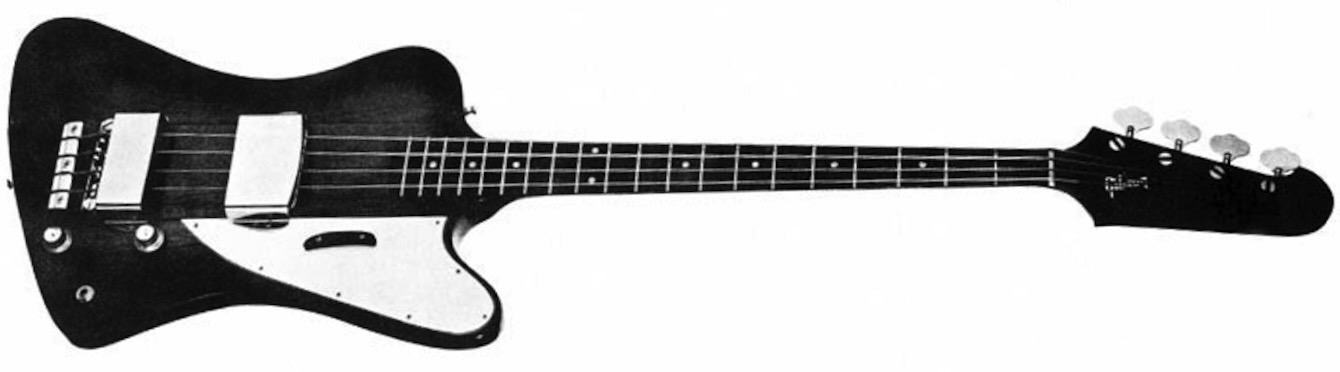
- Thunderbird II
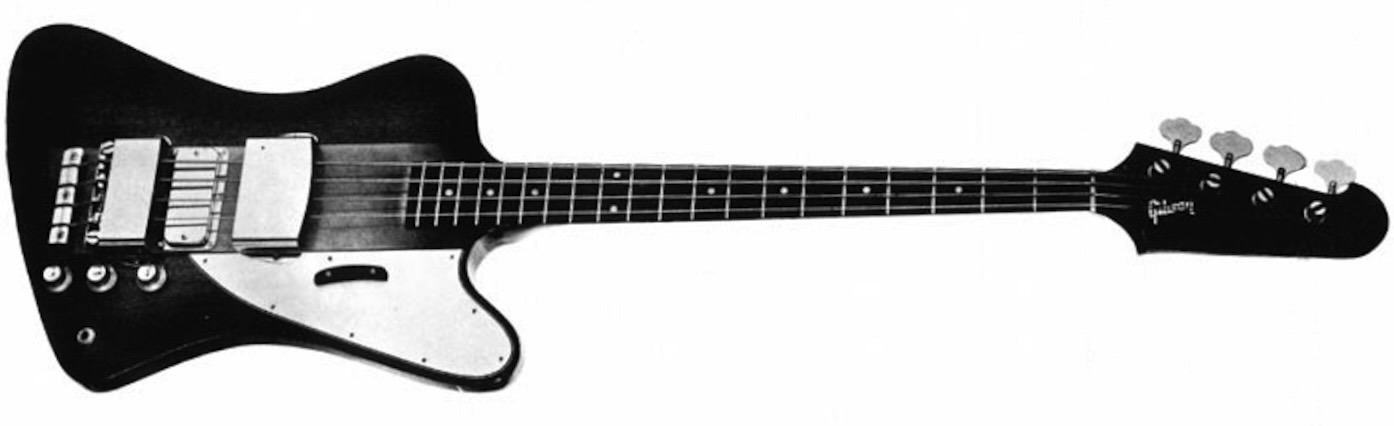
- Thunderbird IV
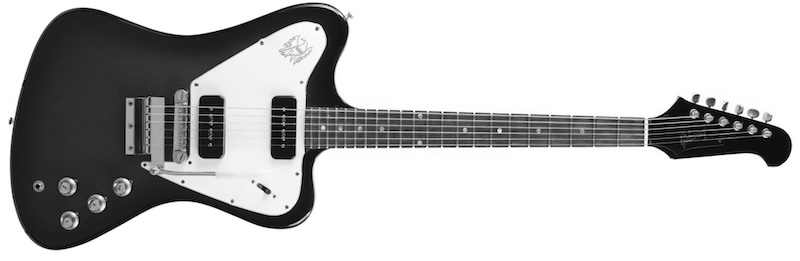
- Non-reverse Firebird
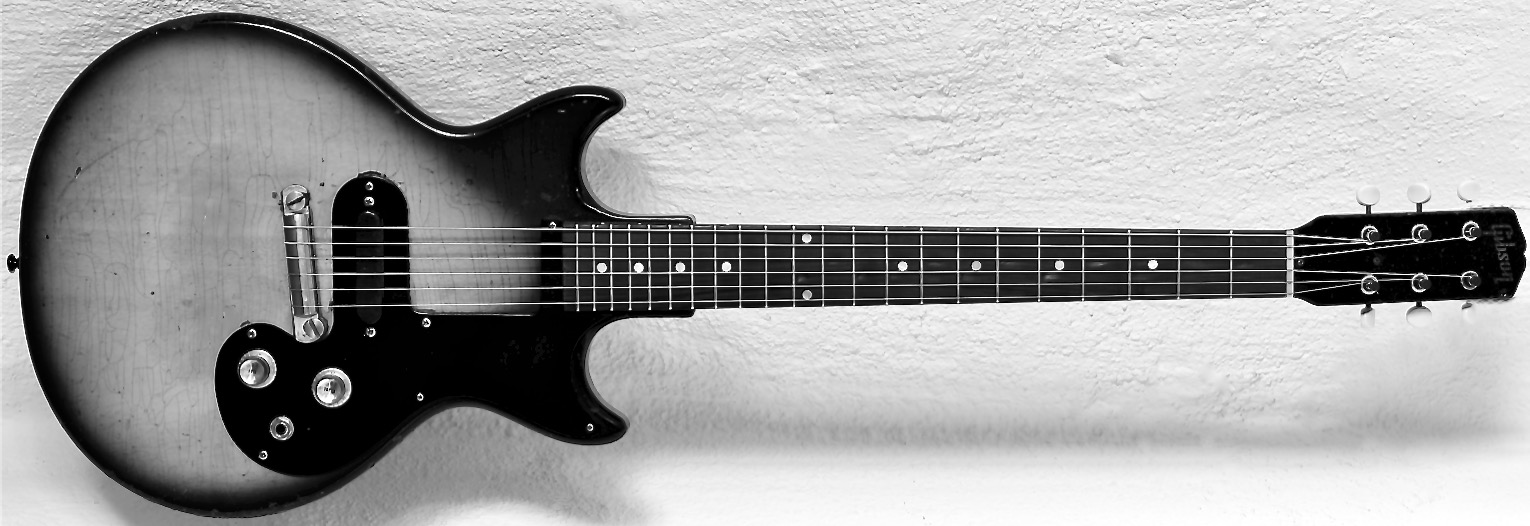
Melody Maker
- Introduced 1959
- Slab body
- Single rounded cutaway (LP Jr. shape but thinner)
- Oblong pickup black plastic cover no visible poles
- Wraparound bridge/tailpiece
- Knobs mounted on PG
- Unbound rosewood board
- Dot inlays
- Narrow peghead
- Decal logo
- Sunburst
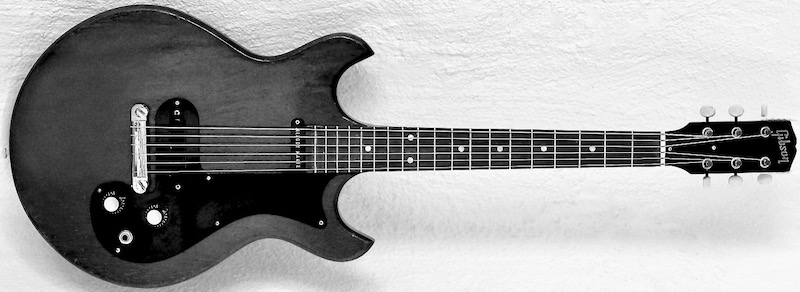
1960
- Narrow pickup width
- Melody Maker-D 2 pickups available 1960–70
- 1961 Symmetrical double cutaway with rounded horns, slightly rounded body edges
- 1962 Maestro vibrato optional
- 1963 Cherry finish body with horns point farther away
1966
- SG body
- White pickup covers
- Enlarged white PG
- Knobs mounted on top
- Gibson vibrato standard
- Fire engine red or pelham blue
- 1967 Melody Maker-D Sparkling burgundy optional
- Fire engine red color discontinued replaced with sparkling burgundy
- 1967 Melody Maker-12 string avail. 2 pickups, no vibrato
- Melody Maker-3 avail. 3 pickups
- 1968 Walnut optional
- 1969 Walnut finish only, wider peghead
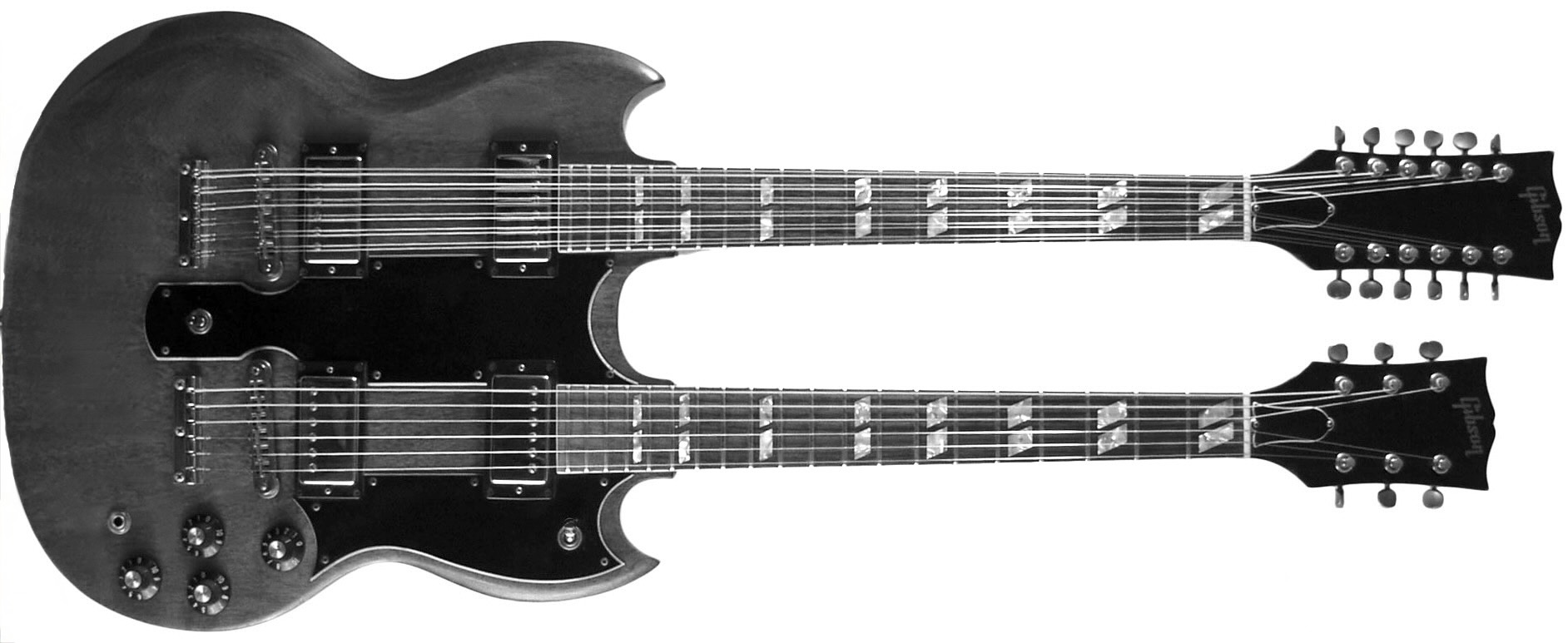
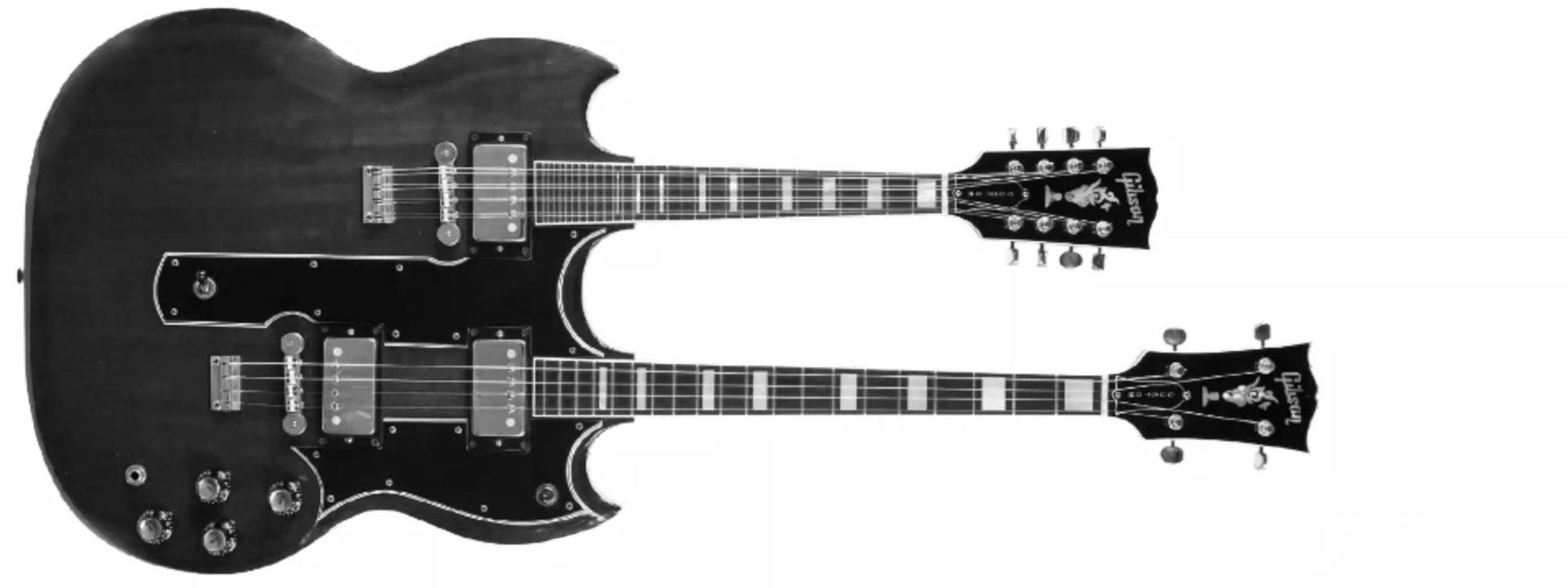
EDS "Double 12"
- EDS-1275 12+6
- Originally introduced in 1958, with various production runs until present (SG body style in 1962)
- One 6-string and one 12-string
EBS
- EBS-1250 4+6
- 1962-1968, with a brief reissue in 1977-1978 (2ex)
- Blend of SG and an EB bass
- Earlier models (known as EBSF-1250) included an onboard fuzz effect
- Fewer than 30 units manufactured
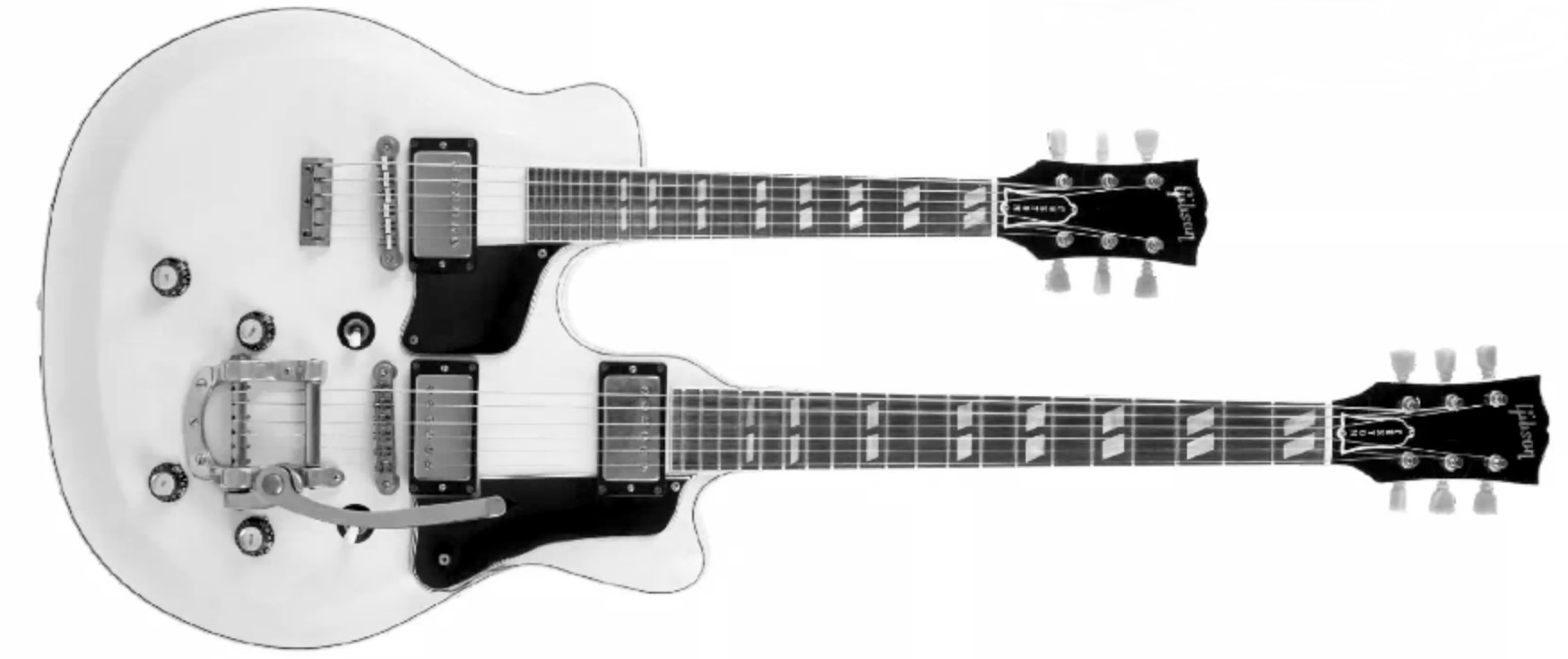
EMS
- EMS-1235 6+6
- Introduced in the late 1950s and continued into the 1960s
- 6-string guitar neck and a mandolin neck
- The EMS has variants, different body styles and appointments
Archtops
Gibson Suffixes (1940s–1960s) – Quick Guide
* ES = Electric Spanish (standard electric guitar, not lap steel)
* P = Premier (early designation for a cutaway model, e.g. ES-350P)
* T = Thinline (thinner body)
* D = Dual pickups (two pickups)
* C = Cutaway (single cutaway body)
* CES = Cutaway Electric Spanish
Examples
* ES-350P = Electric Spanish 350, Premier (cutaway)
* ES-350T = Thinline version
* ES-350TD = Thinline, Dual pickups
* ES-125D = Dual pickups
* ES-125TDC = Thinline, Dual pickups, Cutaway
* Super 400 CES = Cutaway Electric Spanish
Over time, Gibson moved from using P (Premier) to the more explicit C (Cutaway), and suffixes gradually became a shorthand specification system describing a guitar’s construction and electronics.
L-5
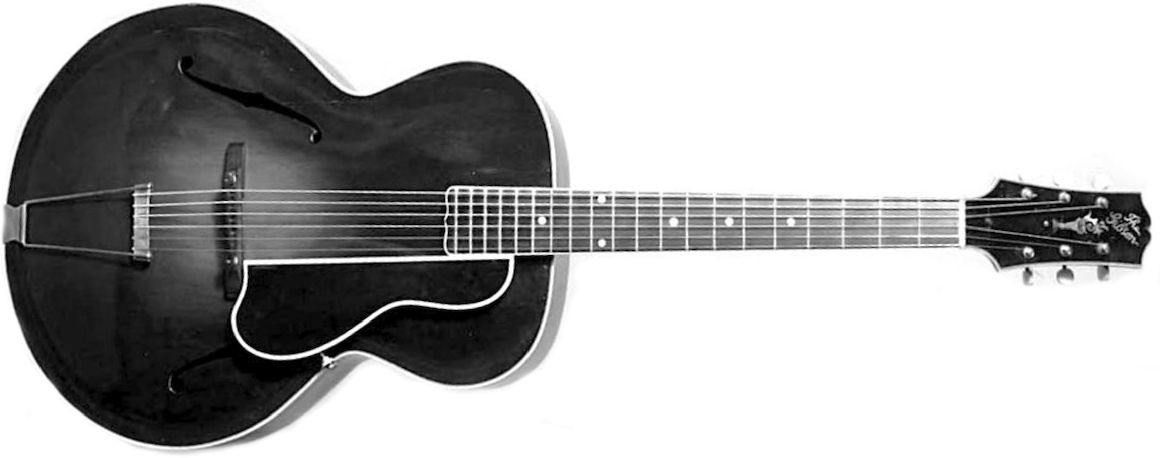
Lloyd Loar, an acoustic engineer and designer, worked for the Gibson Guitar Corporation in Kalamazoo, Michigan. He revolutionized guitar design by creating the Gibson L-5, the first F-hole guitar. Introduced in 1923 and still in production today, the L-5 marked a significant departure from traditional guitar designs. Drawing inspiration from the cello family of instruments, it introduced innovative design principles that transformed the guitar landscape. Initially offered as an acoustic instrument, the L-5 didn’t become available with electric models until the 1940s.
Gibson electric archtops in the 50s and 60s
Some of the most sought-after guitars for jazz players and rock pioneers are Gibson’s electric archtops. Although Gibson had been producing electric archtops since the 1930s, it was during the post-war era that they truly reached their zenith of innovation and popularity. During this period, some of the most iconic models were introduced, including:
ES-350
It boasted gold-plated hardware, a single Venetian cutaway, and two or three P-90 pickups. Jazz legends like Tal Farlow and Barney Kessel, as well as rock icon Chuck Berry, favored these guitars.
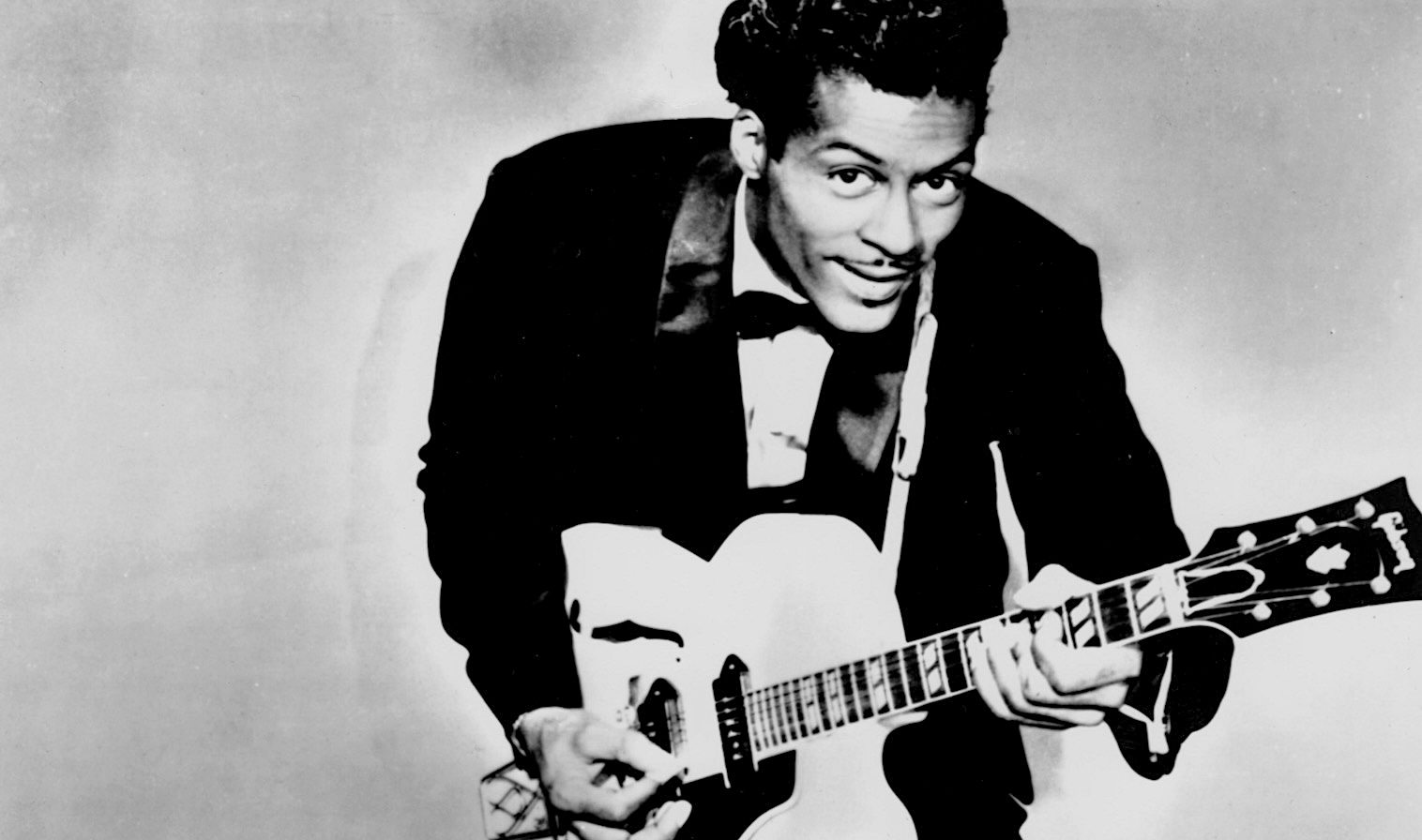
Chuck Berry and 'The ES-350' from 1955. (”Chuck Berry” Photo by Anonymous, uploaded by Unknown, n.d., www.lespaulforum.com)
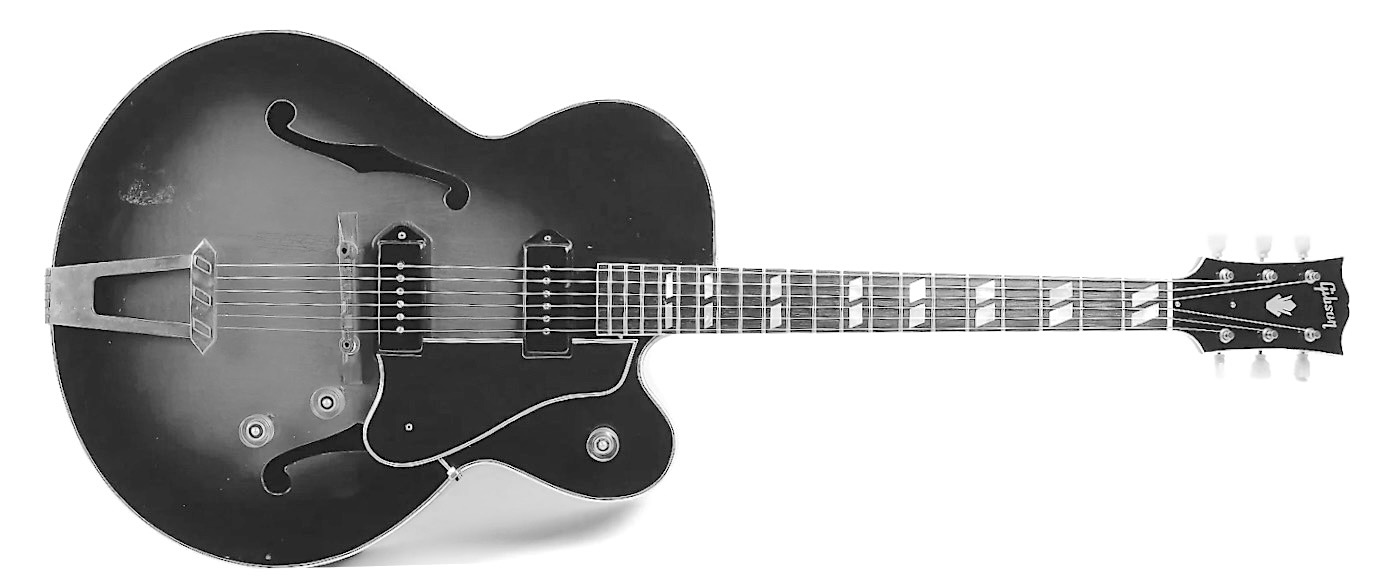
The ES-350 was introduced in 1947 as the ES-350P, a cutaway version of the ES-300. The ES-350 enjoyed its moment in the sun as Gibson’s premier electric archtop until 1949 and the arrival of the ES-5.
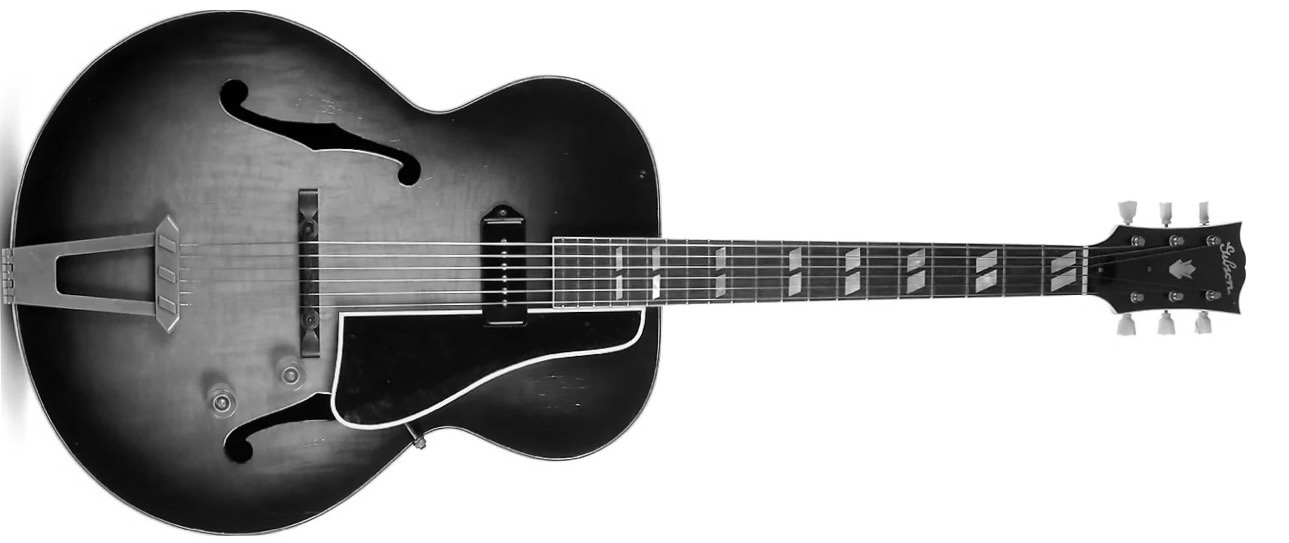
ES-300
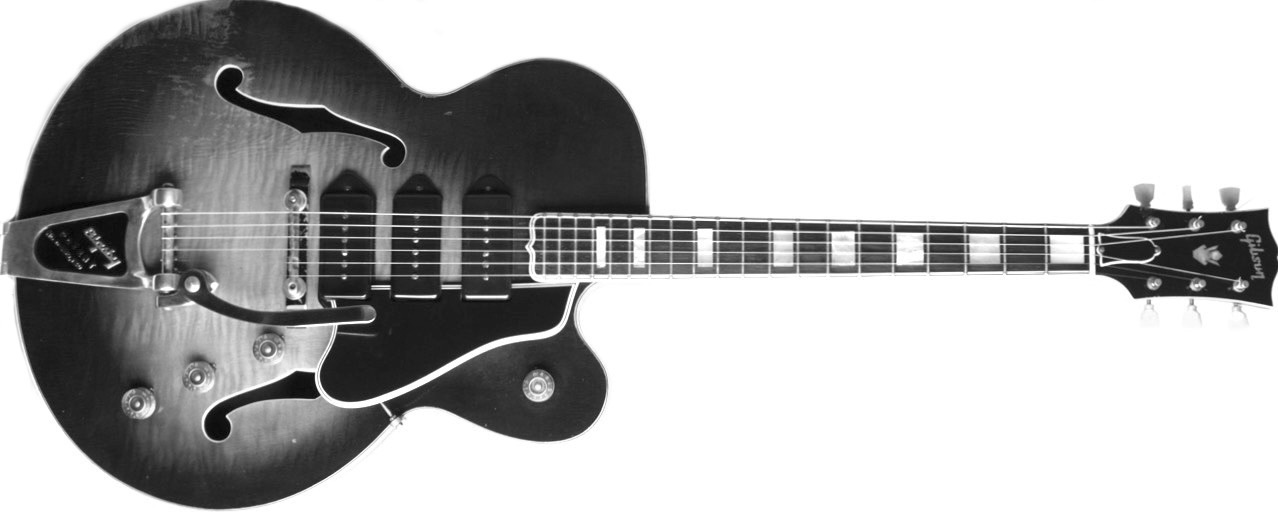
ES-5 "Switchmaster"
The ES-5, released as a triple-P-90-loaded version of the L-5C. Built for optimum performance as an electric instrument. Laminated maple body, a solid spruce top, and Venetian cutaway. Notably, it was one of the pioneering guitars to incorporate a four-way switch, allowing for diverse pickup combinations. Plywood construction.
The L-5 CES and Super 400 CES
Launched in 1951, these electric versions of Gibson’s top-of-the-line acoustics boasted solid carved tops and backs, dual P-90 or Alnico V pickups, and luxurious appointments such as pearl inlays, multi-ply binding, and gold-plated hardware. Legends like Wes Montgomery, Kenny Burrell, Herb Ellis, and Scotty Moore graced the stage with these instruments.
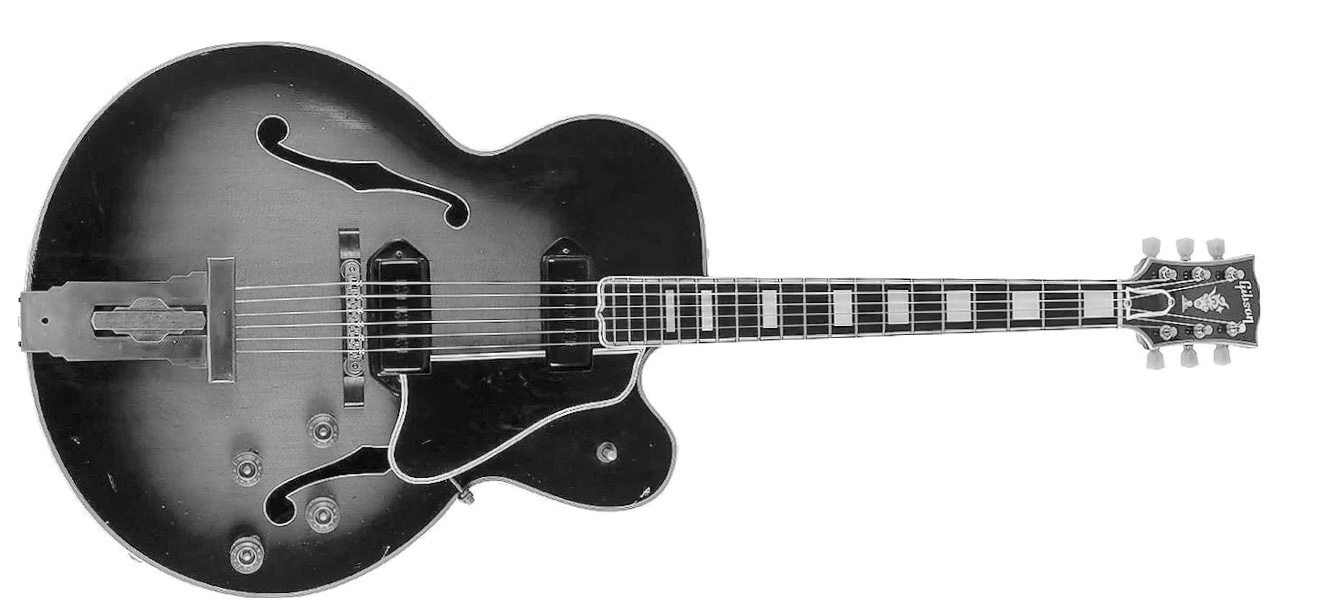
L-5 CES
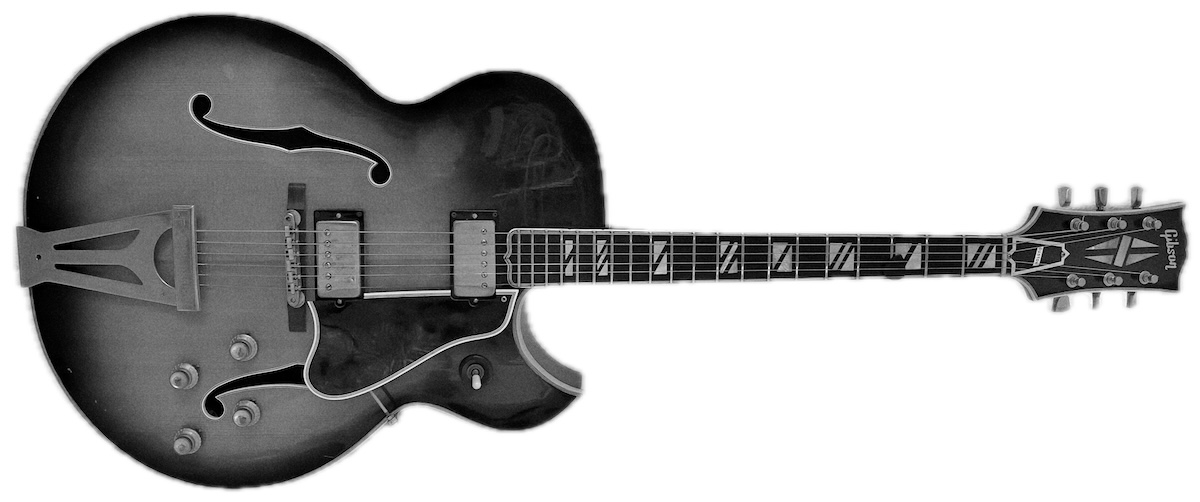
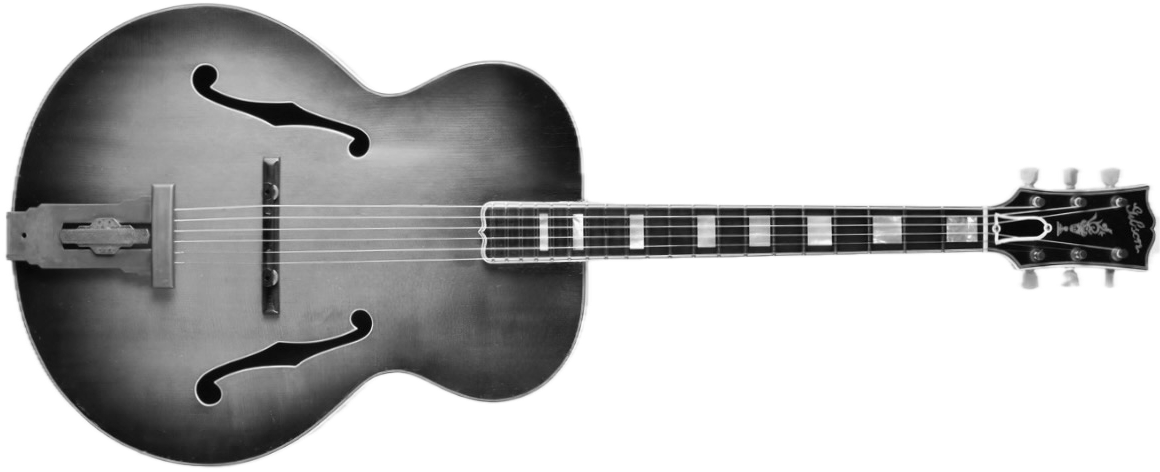
Super-400 CES
The Super-400 CES, introduced in 1951 alongside the L-5 CES, epitomized Gibson’s craftsmanship at its peak. Spanning 18 inches across, this grand archtop boasted impressive features, including large, intricate inlays, multiple-ply binding, and gold-plated hardware from top to bottom. It stood as the largest of Gibson’s archtop models, available in either Sunburst or Natural finishes. The Natural variant, with an ’N’ suffix (Super-400 CESN), is particularly sought after. Crafted with a carved spruce top and solid maple back and sides, the Super-400 CES shared a similar construction to the L-5 CES. Both models underwent pickup changes, transitioning from P-90 units to Alnico units in late 1953 and later to PAFs in 1958. Notably, in 1960, the cutaway was redesigned to a Florentine style before reverting to the original Venetian design in 1969.
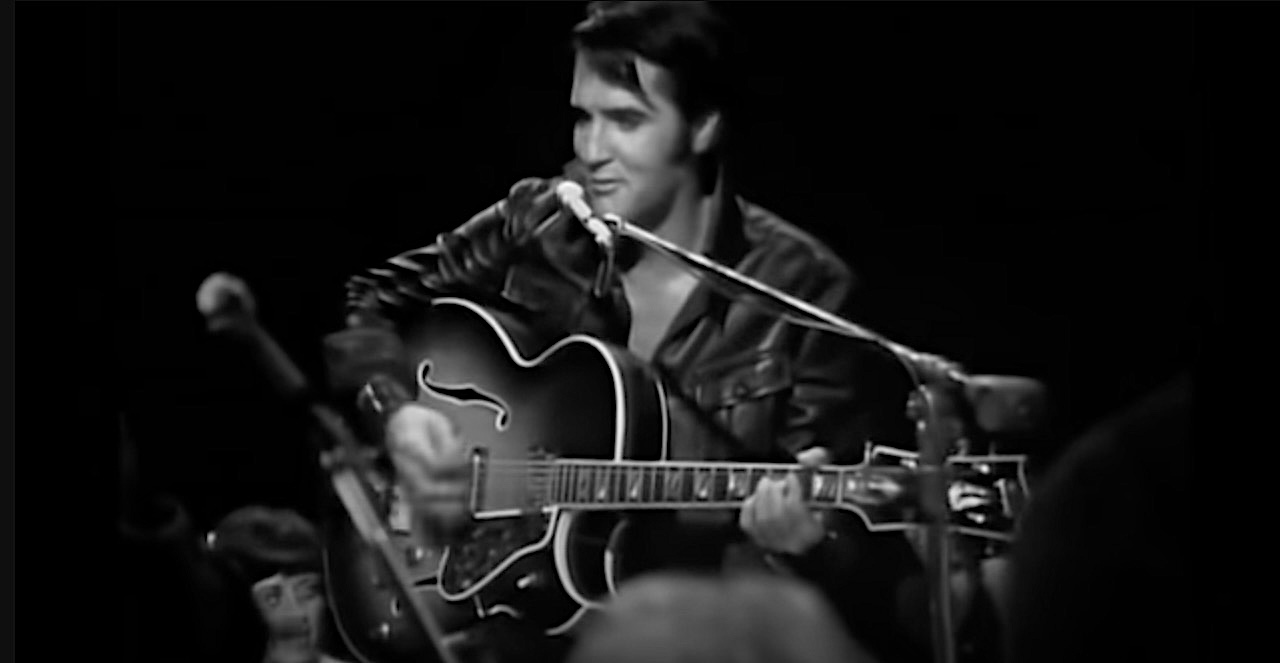
Elvis '68 Comeback Special, with Scotty Moores S-400 from 1963. (”Elvis 68 Comeback Special” Photo by Anonymous, uploaded by Unknown, n.d., www.lespaulforum.com)
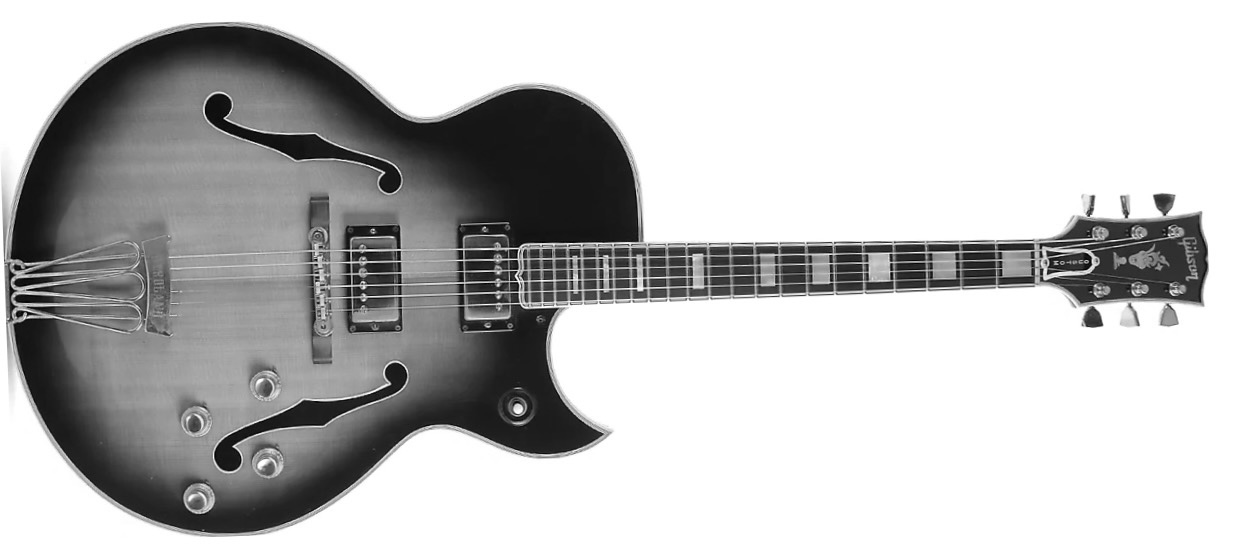
The Byrdland
The Byrdland, a guitar model crafted by Gibson in collaboration with the legendary musicians Billy Byrd and Hank Garland, shares a striking resemblance to the L-5CES. However, it boasts a thinner body and a shorter scale length. This guitar is the first in Gibson’s Thinline series. The Byrdland was equipped with PAF humbuckers at the end of 1957, which were later replaced by Patent number humbuckers in 1962. Four prototype instruments were crafted and registered in April 1955, bearing the designation ’L5-CES spec. thin model’.
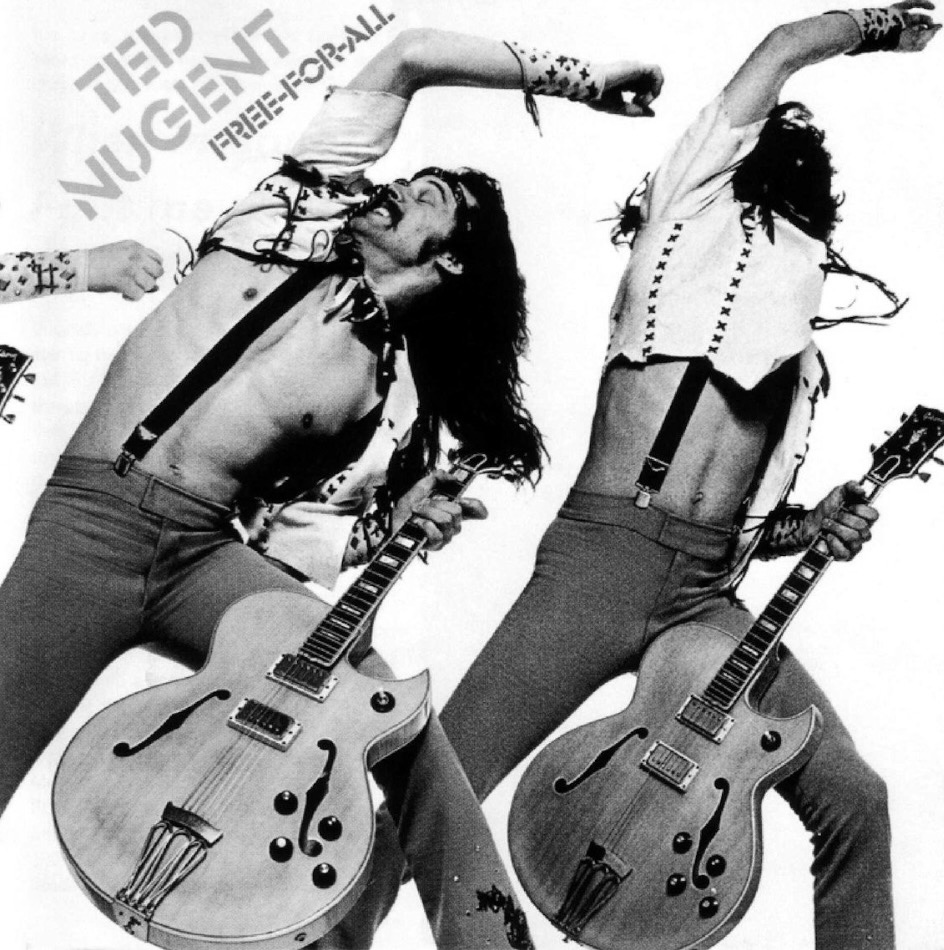
Ted Nugent's 'Free for All' cover. Byrdland N florentine cutaway from the 60s. (1/130 ca. tot.)
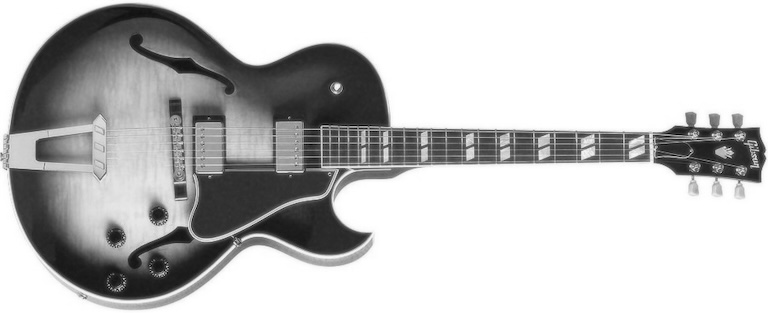
ES-175
In production since 1949. The original ES-175, featured a single P-90 pickup, In the 1950s two P-90 pickups, In the late 1950s PAF pickups. Sunburst finish, dark brown to a lighter yellow/amber. ES-175 (One Pickup), ES-175N (Natural), ES-175D (Two Pickup), ES-175DN (Two Pickup, Natural).
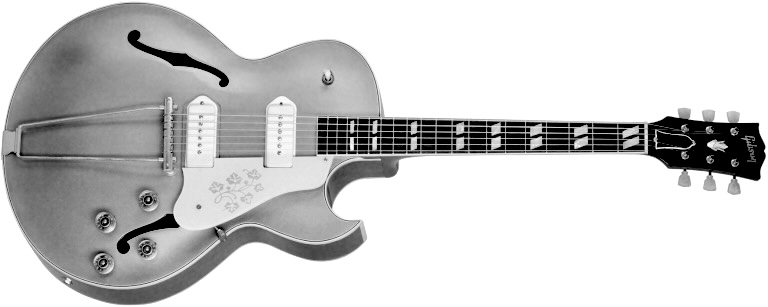
ES-295
Produced during the years 1952 to 1958, with a total of 1770 units made. Gold. Reintroduced in 2010.
Archtop Cheat Sheet/Quick Reference
Flower pot and Blocks: L4/L-5 CES and Thin Byrdland.
Squashed Frog and Paralellograms: ES-175/295/300/350. (L-7).
Squashed Frog and Blocks: ES-5 Switchmaster.
Diamond and Split-block inlays: S-400.
Other Gibson Artist models
1961: Johnny Smith
1961: Barney Kessel
1962: Tal Farlow
1964: Trini Lopez
1969: Les Paul Personal & Professional
1971: Les Paul Recording
Bass
1953: EB(1)
1958: EB2
1959: EB0
1959: Explorer bass (One example known to exist)
1960: EB6
1961: EB0F (Fuzztone)
1961: EB3
1963: Thunderbird
1966: EB2D
1966: Melody Maker
1966: Thunderbird (Non-reverse)
1969: Les Paul Bass
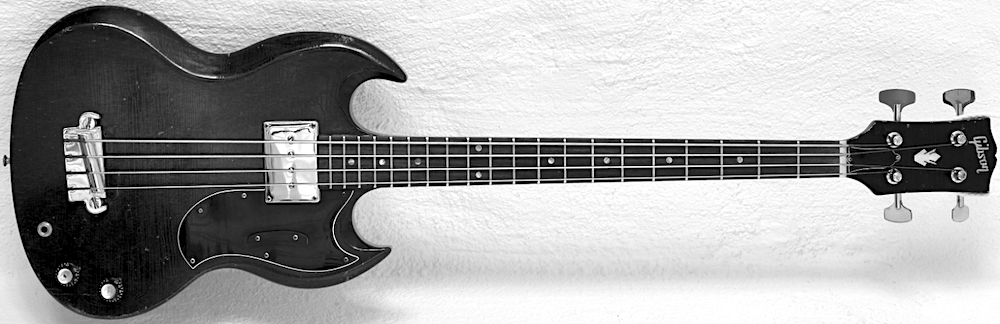
EB0 1966
Gibson mid 70s
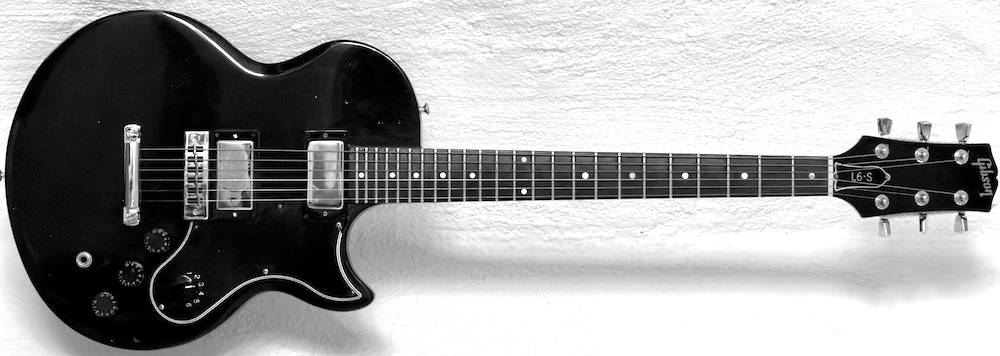
L-6S
The concept was to create a new solid body line apart from the SGs and Les Pauls with what were considered more up-to-date features at the time. The L-6S has a wide but thin-rimmed contoured body of laminated maple and a slim 3-piece maple neck with a dot-inlaid ebony fingerboard. The headstock is a subtle variation on the 1920s "Snakehead" design instead of the traditional Gibson style, fitted with Schaller/Gibson tuners. The two pickups are Ceramic-magnet humbuckers with no polepieces, mated to a 6-way rotary selector giving different phase and parallel/series combinations, an obsession at the time. This model was the first collaboration between Gibson and Bill Lawrence, who designed these newer humbucking pickups.
L-6S
- 1973-1975
- Single-cut solid body, 2 humbucking pickups, 6 position rotary switch, stop tailpiece.
- Renamed L-6S Custom in -75.
L-6S Custom
- 1975-1980
- 2 humbucking pickups... stop tailpiece.
- -78 Silverburst option
L-6S Deluxe
- 1975-1981
- Single-cut solid body, 2 humbucking pickups, no rotary switch, string thru body design.
- Ended in -81, reissued in 2011.
Other Gibson solid body mid 70s models
1973: L-5S
1974: Marauder
1974: Midnight Special
1975: S-1
1977: RD